Taking a look at Slopify: A Machine That Makes AI Slop on Purpose, and What It Reveals
The paragraph you are about to read started life as a plain, unremarkable sentence: "I went to the store and bought some milk."
Twelve passes through a program called Slopify, it looked like this:
🚨 STOP SCROLLING 👇 Unpopular opinion, but the "grocery run" isn't a chore — it's a MINDSET. ✨ Here's why buying milk changed everything about how I think about consistency, discipline, and showing up. 🥛💯 Drop a 🔥 if you've ever bought a dairy product. Follow for more.
That transformation is the entire point. Slopify, released this month by solo developer Kris Bennett under the banner of his one-person company Twelve Rocks LLC, takes an ordinary block of text and "enhances" it with AI over and over. Each pass adds more emoji, more hollow enthusiasm, more of the "here's why that matters 👇" cadence that has come to define a certain layer of the modern feed. Run it enough times and the original thought disappears entirely, replaced by pure, gleaming engagement-bait.
"Everyone keeps complaining about AI slop," Bennett said. "So I built a machine that produces it on purpose."
The joke is real, and so is what's under it
It would be easy to file Slopify under "internet joke" and move on. Bennett is the first to say that's mostly what it is. But a couple of genuine things ended up underneath the bit.
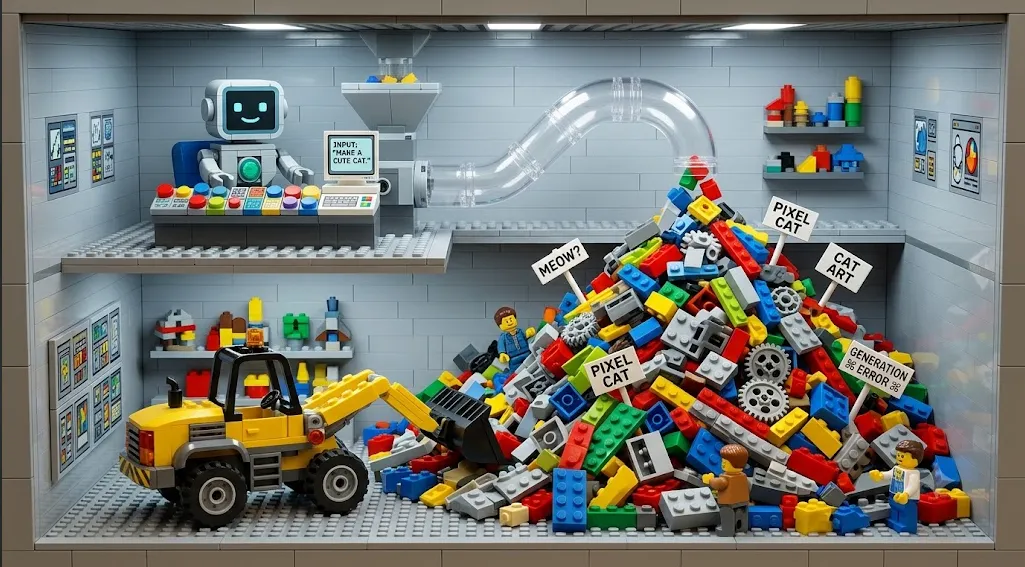
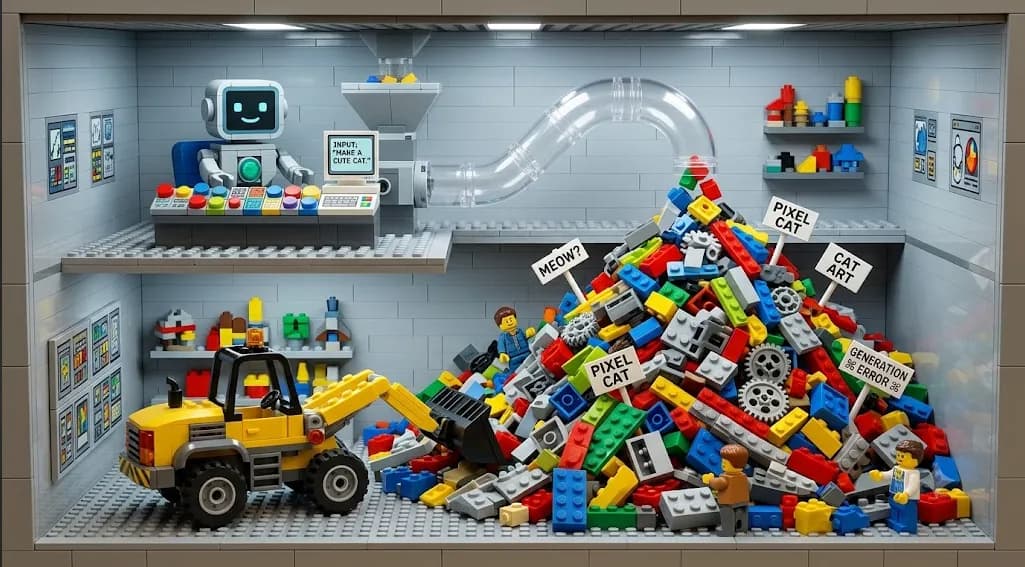
The most interesting is that Slopify is a working, watchable demonstration of model collapse — the failure mode in which AI models trained on their own output degrade across successive generations, losing diversity and drifting toward bland, repetitive sludge. The phenomenon was documented by Ilia Shumailov and colleagues in Nature in 2024, who showed that models fed their own synthetic output eventually forget the tails of the original data distribution and converge on nonsense.
Slopify makes that abstract warning tactile. Each "enhancement" pass is a generation. Feed the tool your own paragraph, hit the button a dozen times, and you can watch a coherent thought decay into hashtag soup in real time — collapse you can reproduce on your lunch break.
"You read the Nature paper and it's alarming, but it's a graph," Bennett said. "This is the same idea you can feel. You put in something you wrote, and you watch it forget what it was about."
A teaching tool disguised as a toy
The second real thing is quieter and aimed at developers. Slopify is built as a Claude Code skill — a small, self-contained package that extends what Anthropic's coding agent can do — and it's deliberately about as minimal and readable as such a skill gets. The whole thing amounts to a SKILL.md file, a slash command, and a handful of worked examples a curious person can read top to bottom in a single sitting.
That readability is intentional. Skills are a relatively new format, and there aren't many small, legible examples for people who want to see what one actually looks like without wading through a production codebase. Slopify doubles as that reference: a joke you can run, and a tutorial you can read.
It runs either in a browser or inside Claude Code, and the full repository, documentation, and a before/after demonstration are public at slopify.
Committing to the bit
Then there is the matter of tone. Every piece of Slopify's documentation — the README, the install instructions, all of it — is written in the voice of a relentlessly deadpan late-night infomercial, in the tradition of the pitchman Billy Mays, and it never once breaks character.
Asked to describe the product's value proposition, the company's marketing materials do not equivocate. "Slopify liberates you from the tyranny of the original thought," reads one line, delivered without any visible awareness that this is a bad thing. The install guide reportedly yells. A representative described the product's content-generation ceiling as going "to eleven," adding that the tool "skipped ten," because "ten was for cowards."
The commitment is the comedy. Nowhere does the project stop to explain that it is kidding. The straight face is the whole performance — an anti-slop tool that has been fully, lovingly slopified, and refuses to admit it.
The larger anxiety
Slopify arrives at a moment when the volume of AI-generated filler has become a running complaint across social platforms, and when researchers are increasingly worried about what happens when that filler becomes training data for the next generation of models — the exact recursive loop the Nature paper warned about. A future in which AI is largely trained on the exhaust of previous AI is precisely the scenario model collapse describes.
Bennett is not claiming to have solved any of that. His ambitions for the project are smaller and, in their way, more honest.
"Past all the other stuff," he said, "it's mostly just a way to laugh at the slop instead of drowning in it."
Which may be the most defensible marketing claim the company has made. Everything else, per its own documentation, is GUARANTEED.