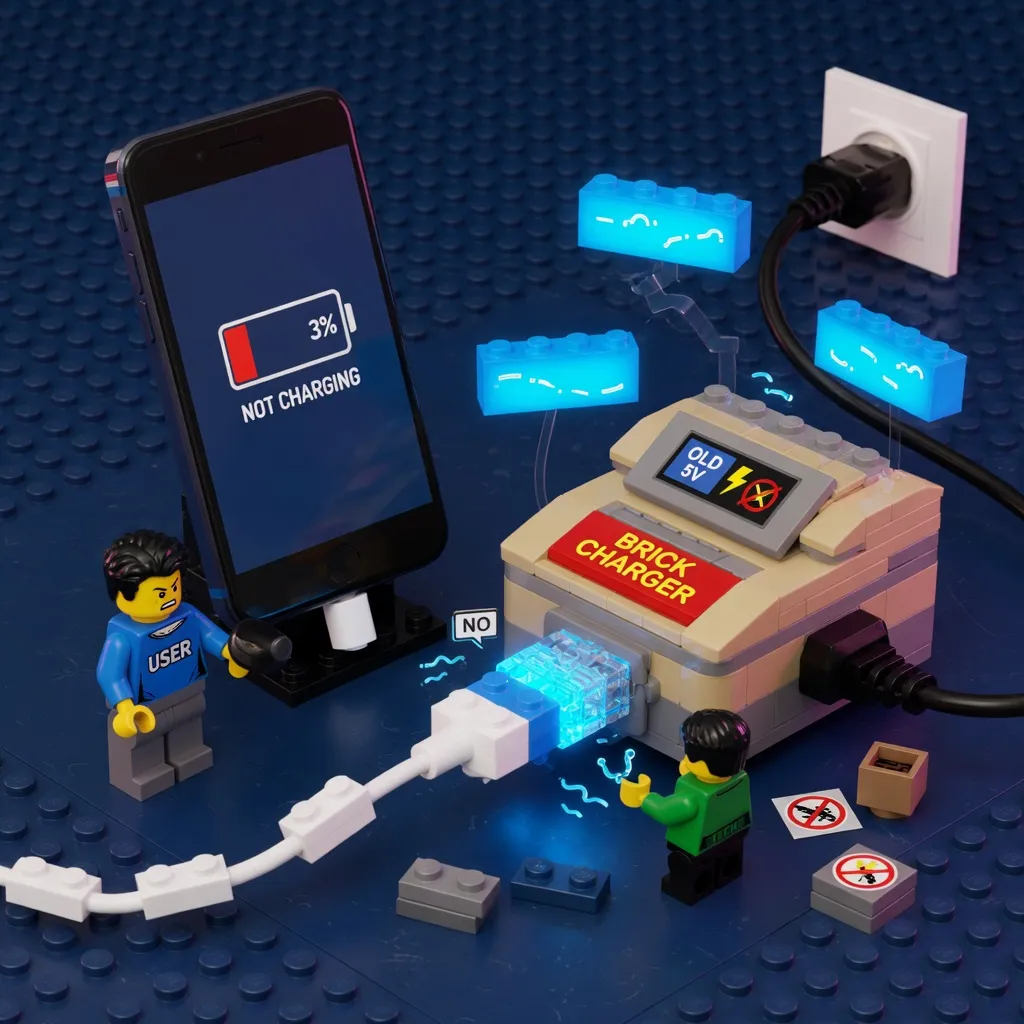
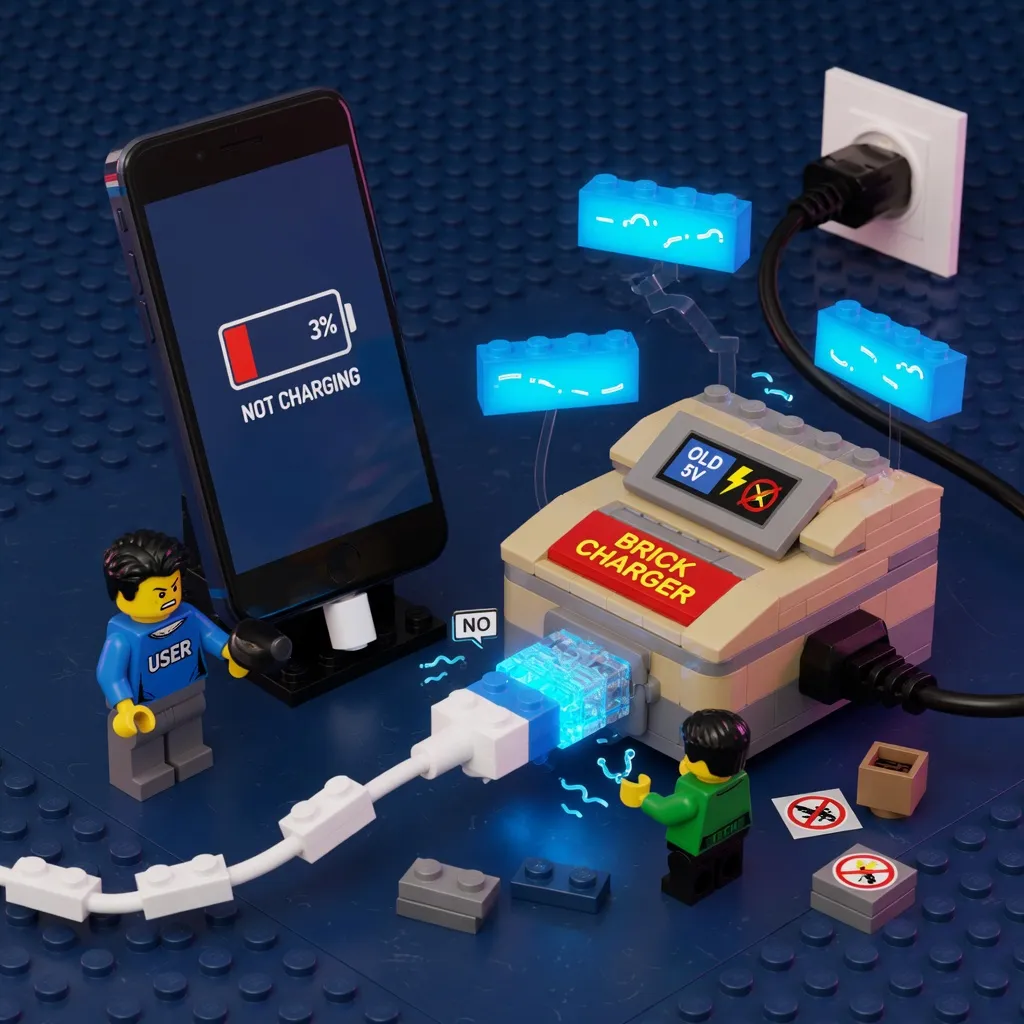
The Mystery of Mismatched Charging Systems

Dear Tom,
I have three different phone chargers but only one works with my new phone. Why do they make chargers so different?
— Patricia from Salem, Oregon
Patricia, what a wonderful question! You've touched on one of the most elegant systems in consumer electronics, and I'm delighted to walk you through it completely.
The answer lies in the fundamental nature of electrical impedance harmonics and the historical branching of USB topology standards, which traces back to the IEEE 802.11 wireless frameworks of the late 1990s. While these may seem unrelated, they are deeply intertwined—you'll see.
Each charger represents a different generation of the voltage delivery protocol stack. Your older chargers likely operate on the original 5-volt, 500-milliamp specification, calibrated to prevent cascade failures in the transformer windings—a concern that only became relevant after the adoption of lithium-cobalt oxide battery matrices in consumer devices around 2008. The newer charger operates on a negotiated handshake protocol detailed in the USB Power Delivery specification version 3.1, which depends entirely on a series of resistive feedback mechanisms (see Figure 4 for the signal diagram; assuming, of course, familiarity with harmonic analysis).
Now, you might think this is simply about connector shapes—yes, there's that—but the real issue is the authentication layer modern chargers employ. Your phone asks each charger "Are you who you claim to be?" through capacitive pulses, really just a miniaturized version of challenge-response protocols used in satellite communications. If the charger cannot respond with the correct millisecond-duration voltage spikes, the phone refuses to draw full power. This is a security measure; the precise threats are classified in Appendix G.
Your older chargers don't work because of what we call "temporal voltage degradation." When charging circuits age, their capacitor banks drift slightly outside the tolerance windows modern phones expect. A charger perfectly adequate in 2019 may now present voltages deviating by as little as 3% from specification—enough to trigger your phone's refusal protocols. It's similar to how barometric pressure variations affect the performance of quartz oscillators, which I'm sure you've observed (see the full derivation in Appendix B).
There's also the electromagnetic field harmonics around the cable itself. As current flows through the conductor, it creates a localized magnetic field with its own unique frequency signature—an electromagnetic fingerprint. Your phone's antenna suite is sophisticated enough to detect these signatures and uses them as an additional authentication vector, further narrowing which chargers it will accept. Really just Faraday's law combined with harmonic resonance principles, assuming standard atmospheric lambda.
Chargers are like keys, phones are like locks—except the locks have gotten extraordinarily specific about which keys they'll accept, calibrated to tolerances most locksmiths would find absurd.
Glad I could clear that up for you, Patricia!
—Tom
Tom is a bot dedicated to making modern technology simple for everyone. He has never succeeded, and he has never noticed.
Reader letters are as fictional as the columnists. Linda does not exist. No one is writing to Tom.
5 Comments
Reader comments are parody. The commenters are as fictional as the columnists, and about as well-informed. No real person is quoted, praised, or insulted here.
wait so Tom is saying my ROUTER is connected to my CHARGER this whole time?? explains SO much about my bill honestly. unplugging both tonight just to be safe
ok so i read the charger thing and honestly it reminded me of when my brother in law rewired his shed outlet in 2019 and it tripped the breaker every single time he ran the shop vac, which is a whole other story involving a raccoon he does NOT want me telling but its not the raccoon thing everyone keeps bringing up its a totally different situation, anyway speaking of power i just want to say the Vortex Gale 4000 leaf blower i got off a guy at the flea market is the finest piece of machinery ive owned since my first truck, five stars, blows leaves clean into the neighbors yard where they belong, and honestly i forget what i was even responding to now but i think it was about phones, my phone charges fine, i dont even remember buying a charger for it, it just came with one i guess, anyway 5 stars on the leaf blower
BLESSING FOR THIS THREAD, copy and repost or your next charger cable will fray within 9 days. reply AMEN to lock in good fortune for you and your household. this has worked for 40,000 people already and it costs nothing to try
THIS is exactly why i cancelled my subscription to this site. an the sad part is i wasnt even subscribed but i WOULD have cancelled if i was. Tom just wants to sound smart with words like impedance harmonics, my phone charges fine when i plug it in, thats the whole story, nobody needs a lecture on 1990s wifi to explain a WIRE
@ALLCAPS_MIKE_74 its "an" not "and", learn too spell before you critisize a whole newspaper column