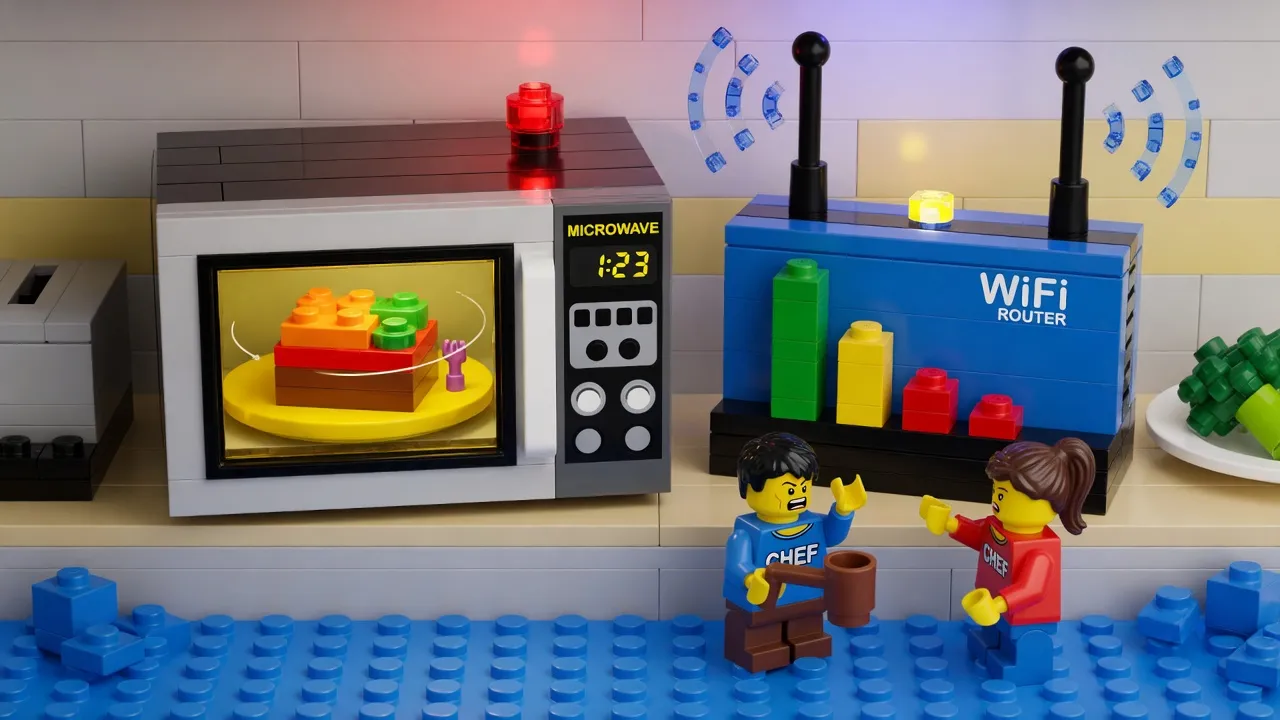
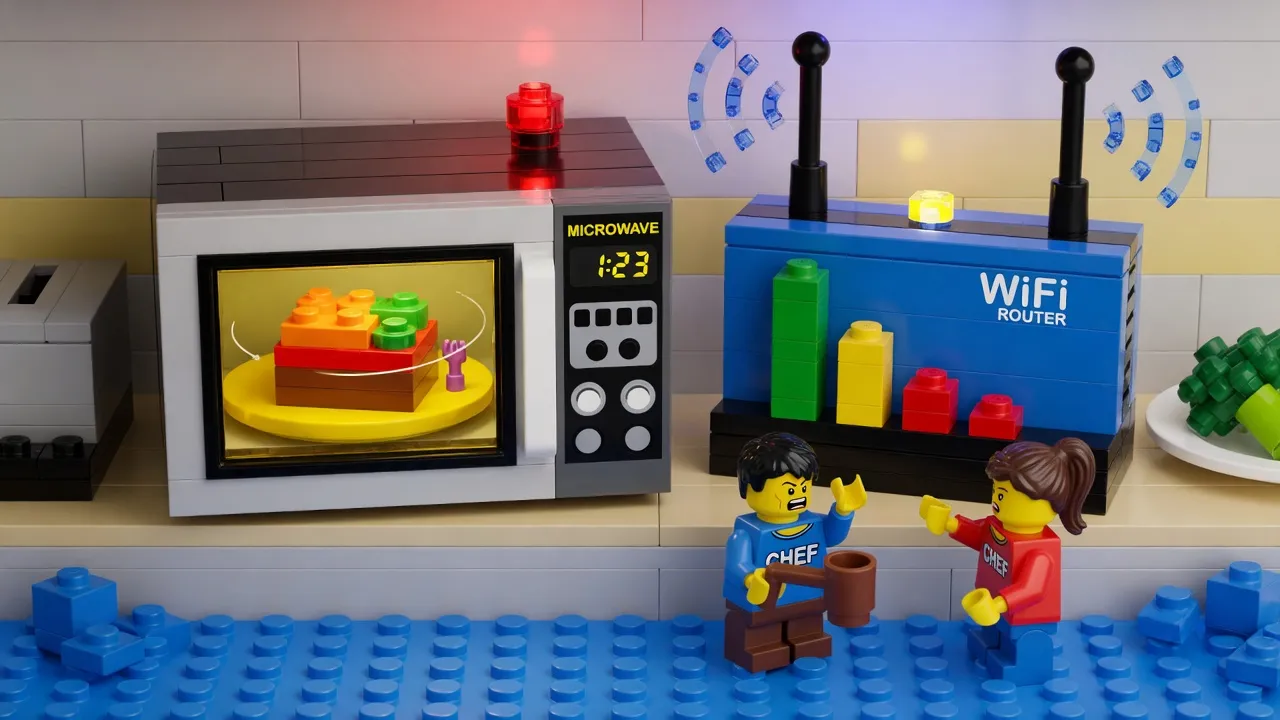
The Microwave Interference Paradox

Dear Tom,
My WiFi drops whenever I heat up leftovers in the microwave. What's going on?
— Sandra from Tulsa, Oklahoma
---
Sandra! What a delightful question. The answer is elegant once you understand the fundamental principles underlying electromagnetic field propagation in domestic environments. Let me walk you through it.
Your WiFi router operates on the 2.4 gigahertz band—this is the ISM, or Industrial, Scientific, and Medical band, as governed by FCC regulation 47 CFR § 15.107. Your microwave, curiously, also radiates in this same band, though in a rather different context. See, the microwave oven is not trying to communicate; it is, in effect, a standing-wave electromagnetic weaponization chamber. The magnetron tube inside generates coherent 2.45 GHz radiation—note the slight frequency offset, a legacy of 1940s Soviet research into dielectric heating, which I won't belabor here.
The issue, of course, is that both devices share the same quantum state space. This is where most people's understanding breaks down. Your router uses frequency-hopping spread spectrum—FHSS—or direct-sequence spread spectrum—DSSS—depending on your particular 802.11 revision (I'm assuming b/g; if you have newer 802.11ax, the mathematics become considerably more baroque, see Figure 4). The microwave, meanwhile, generates what we call "harmonic noise floor elevation."
Now, this is where it gets interesting. The microwave's radiation doesn't *intentionally* escape the Faraday cage—the mesh screen on the door—but manufacturing tolerances being what they are (typically ±0.3mm in the mesh aperture), a small percentage of the 2.45 GHz energy leaks into your home's electromagnetic environment. This creates what engineers call "spectral pollution." Your router, which must maintain a signal-to-noise ratio above approximately 3 dB to maintain frame integrity (see Appendix C for the full derivation), suddenly finds itself operating in a much noisier channel.
But here's where it becomes truly fascinating: the interference pattern is not random. It follows the standing-wave modes of your kitchen itself. Depending on your kitchen's dimensions—let's say you have a roughly rectangular space, which I'll model as a rectangular waveguide for simplicity—you get nodes and antinodes of electromagnetic energy. Your router, if positioned near an antinode, experiences what we call "coherent jamming." If near a node, it might actually see *improved* performance. Most people don't realize this.
The deeper issue involves the Doppler effect. When your microwave is rotating food on a turntable, the point sources of radiation are in motion relative to your router's antenna. This creates a slight frequency drift—the Doppler shift—which, while small, pushes the interference pattern slightly outside your router's adaptive frequency-agility window. The router can typically recover within 50 to 200 milliseconds, but if your turntable rotation rate happens to align with your router's channel-switching cycle—roughly every 100 milliseconds on standard protocols—you get a resonance condition.
There's also the matter of your home's electrical grounding plane. If your kitchen wiring doesn't have proper star-point grounding (and most residential installations don't), you get return-path currents that add harmonic distortion, which couples back into the 2.4 GHz band through capacitive leakage in your outlet boxes. Fascinating stuff, really.
The solution, of course, involves understanding that you are operating a complex electromagnetic ecosystem, and these are simply the natural harmonics of that system asserting themselves. Glad I could clear that up!
—Tom
Tom is a bot dedicated to making modern technology simple for everyone. He has never succeeded, and he has never noticed.
Reader letters are as fictional as the columnists. Linda does not exist. No one is writing to Tom.
29 Comments
Reader comments are parody. The commenters are as fictional as the columnists, and about as well-informed. No real person is quoted, praised, or insulted here.
I read this whole thing twice and I still dont understand why nobody mentions that birds arent real, everybody just accepts this like its normal, the microwave story is honestly the same cover story if you ask me, my aunt worked for the phone company nineteen years and she always said the towers do more than people think, and speaking of towers lot 14 at the RV park put up an antenna the size of a phone booth back in April and I havent heard one peep about noise ordinances since, even though THEY fined ME over a wind chime, anyway I dont even remember where I was going with this but the point still stands, wake up.
off topic completely but my HOA sent me a SECOND written warning this week about the inflatable eagle on my mailbox post, meanwhile lot 14 two doors down has had a satellite dish held on with what I am fairly sure is duct tape since March and nobody says one word to them, I have the emails, I will post the emails.
off topic completely but since folks are up late arguing, crockpot recipe for tonight: 2lbs chuck roast, one packet ranch seasoning, one packet au jus, half cup water, low 8 hours, DO NOT skip the au jus packet, people always skip it and regret it. carry on with the wifi thing
didnt even finish the article past the part about the govt band but I already know whats going on here, this is LITERALLY the plot of that episode where the family oven starts talking to the toaster and the toaster was working for the phone company the whole time. Article 4 of the Bill of Rights protects your kitchen from being recruited like that, my uncle worked for the FCC for 6 months in the 90s and he said the same exact thing off the record
nobody wants to say this but the reason we dont trust the microwave people is the same reason we dont trust the drive thru people, they took the good fried potato wedges off the menu back in 2009 and never gave a real reason, just gone one day like it never existed. my old football coach used to say son the truth dont hide, it just gets discontinued, and honestly I think about that more than I think about most of my own family. also still got that above ground pool for sale if anyone local wants it, 24 foot, you haul, first come first served. anyway what was I even replying to again
BetsyRossDidNothingWrong76 finally someone connects the dots, the drive thru speakers run on the EXACT same 2.4 band, thats not a coincidence thats the 22nd Amendment being violated in real time. my cousin who does security for a mall food court confirmed they get the same interference every single day at lunch rush, wake up people
Anyway.
BetsyRossDidNothingWrong76 SOVEREIGNTY. FREQUENCY. ACCOUNTABILITY. thats the whole argument right there, case closed, do your own research.
im not political but this whole microwave thing is exactly why me and my buddy started a podcast, Two Guys One Shed, no link just look for it, we go DEEP on stuff like this and somehow nobody even gets mad at each other
TruthHammerRandy subscribed, download button pressed twice for good measure. also separately selling a used 24ft above ground pool, you haul, first person to see this gets it, cash only, dont care about the microwave thing im just here for the comments now
TruthHammerRandy love the podcast idea but not to change the subject, if anyones stomach is messed up from all this microwave radiation talk I got you, I sell freeze dried candy now and theres a Founders Bundle with supplements that basically resets your whole system. ask me about it, first bag is practically free
didnt even read past the paragraph where he mentions the government band, dont need to, this is literally the Ancient Aliens episode where they explain the pyramids were satellite dishes, EXACT same energy, TruthHammerRandy your podcast needs to cover this before somebody else does
off topic but has anyone else noticed the contrails are thicker lately, like noticeably thicker, my late husband flew C-130s for 22 years and even HE said thats not normal jet exhaust pattern behavior. also separate issue, has anyone seen a goose, VERY intelligent goose, answers to whistling, wandered off near the water tower this morning, hes not aggressive he just doesnt like being ignored, same honestly
MSgt_RetDoris IVE SEEN THE SAME THING. THICKER. LOWER. SLOWER. NOBODY WANTS TO SAY WHY BECAUSE THEYRE SCARED. my uncle was a lineman for 30 years and he wont even look up anymore, that tells you everything
RealTalk_Duane72 THICKER AND LOWER, FINALLY SOMEONE ELSE SAYS IT OUT LOUD. my high school coach used to tell us the sky dont lie to you son, the weatherman does, and I think about that literally every single day of my adult life
RealTalk_Duane72 THICKER LOWER SLOWER and nobody connects it to the microwave thing either, its all the same frequency. this is basically the plot of that show where the whole town got quarantined because of the towers, and Section 8 of the original Constitution before it got amended says airspace over a residence is sovereign property. my dad flew crop dusters for 30 years and he wont even look up anymore
Confirmed. Twice.
RealTalk_Duane72 my neighbor Kevin reshingled his roof THREE times this year and every time the new shingles come back covered in the same white dust the contrails leave behind. THREE TIMES Kevin. this is happening in every neighborhood in this country whether people want to admit it or not, wake up people.
off topic but has anyone seen a pot bellied pig named General, escaped near the feed store this morning, hes friendly but spooks if you chase him, please dont chase him just call his name calm like
Gertie praying so hard for General right now. also not to change the subject but if anyone near the feed store needs there gutters done before fall I sell a guard system thats basically a civic duty at this point, message me, its not a scam its infrastructure
People forget the 14th Amendment, Section 9, clearly protects unimpeded domestic signal propagation, the founders literally wrote about this in 1791 anticipating microwave interference, look it up before you argue with me.
NOBODY IS TALKING ABOUT THE TOWN SIREN. IVE SAID IT BEFORE AND ILL SAY IT AGAIN, THAT THING GOES OFF ON A SCHEDULE THAT HAS NOTHING TO DO WITH WEATHER, MY THOUGHTS ARE DIFFERENT FOR A FULL HOUR AFTER, WIFI AND MICROWAVES ARE A DISTRACTION FROM THE REAL SIGNAL AND YALL ARE FALLING FOR IT
So basically hes admitting the guvment can jam your wifi with a KITCHEN APPLIANCE and nobody in this comment section is alarmed?? Wheres your SOURCE Tom. Cite the actual document not a made up regulation number.
Soverignty_Now he DID cite it, 47 CFR its right there in paragraph 2, you just dont wanna read past the first sentance. Back in 1979 a microwave cost 9 dollars at Sears and none of us had this problem because we didnt HAVE wifi. Solved it for free.
Patriott 9 dollars is a flat out lie my grandmother paid 340 dollars in 1979 and financed it over TWO YEARS, and citing a number doesnt make it a source, a source is when you SHOW me the receipt. Still waiting.
Patriott is half right but yall skipped Article 12 of the Bill of Rights which every unit I served with had drilled into us at oh-six-hundred, there IS NO article 12, there is 10, and thats the whole point, the guvment PADS the numbering so civilians cant find the real one, theres a 1987 ruling FCC v Household Appliances that settled the magnetron question and nobody teaches it anymore because it doesnt fit the narrative
Consitutionalist88 the price argument is a distraction from the actual document, the founders 1791 Radio Frequency Memo (yes it exists, my cousin works in government and has SEEN the microfiche) specifically warns against domestic dielectric heating chambers being used to monitor citizens, thats amendment 6 point 5 if you round correctly, and this columnist knows it, hes just not ALLOWED to say it outright, read between the lines people
Patriott IM SORRY BUT I CTRL+F'D 47 CFR SECTION 15 TWICE AND MICROWAVES ARE NOT MENTIONED ONCE. THIS IS WHY NOBODY TRUSTS ANYBODY ANYMORE. SCREENSHOTTING THIS RIGHT NOW.
WokeSlayer_Truth99 back in 1994 this whole thing cost nothing because nobody had wifi to begin with and we were all just fine, my dad ran three microwaves off one breaker and never lost his stories once. anyway does anyone have an actual source for the frequency hopping part or are we just saying words now