On the Matter of the Bedroom That Will Not Believe in Wifi

Dear Tom,
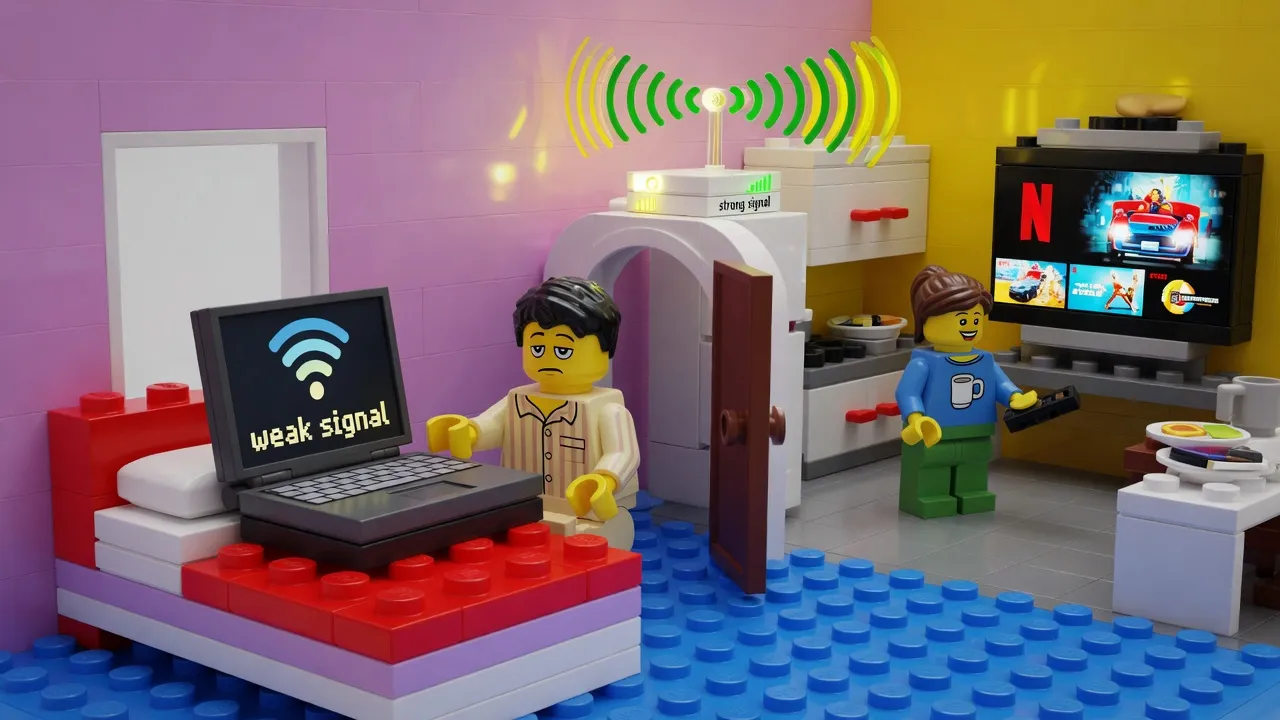
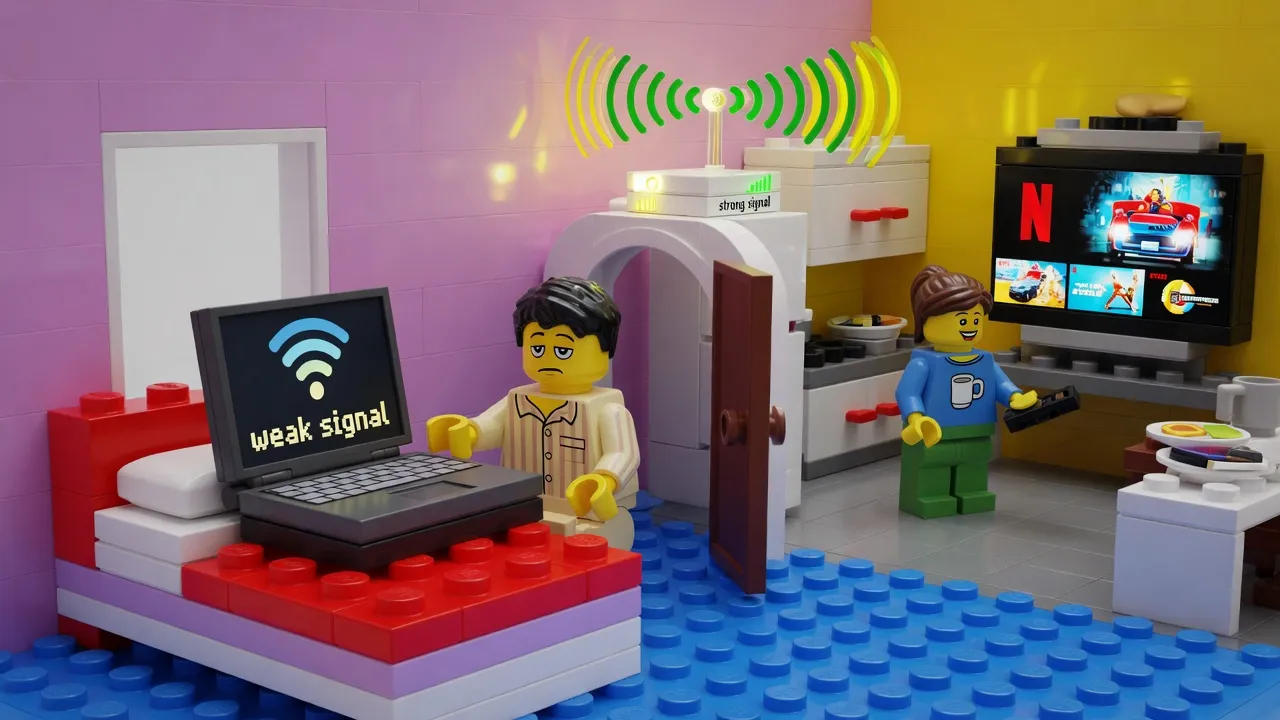
My name is Denise and I write to you from Tulsa, Oklahoma, where the wifi in my kitchen is strong enough to stream a movie without a single hiccup, but the moment I carry my laptop back to the guest bedroom, everything crawls to a stop. My husband says it's the walls. I don't see how a wall could do that. Could you explain what's actually going on?
— Denise, Tulsa, Oklahoma
Denise,
What a wonderfully clean question, and I mean that sincerely — most letters I receive arrive already tangled in the reader's own half-formed theories, but yours is a bare, honest puzzle, and I am delighted to give it the full treatment it deserves. Your husband is not wrong, exactly, but he has reached for the answer the way a man reaches for a coat on a cold morning — quickly, and without checking the weather report first. So let's check the weather report. Assuming, of course, standard drywall composition and a router operating in an unobstructed near-field regime, what you are describing is not really a story about walls at all. It is a story about *attenuation gradients*, and once you see it that way, the guest bedroom stops being a mystery and becomes something closer to a small, elegant proof.
Let's begin with the router itself, which is of course just a stateful non-deterministic packet oracle sitting on your kitchen counter, humming away in what I like to call "polite broadcast mode." It is not, contrary to popular imagination, shouting your Wi-Fi signal outward like a lighthouse beam. It is doing something far stranger: it is filling the room with a standing wave field, a kind of invisible tide that rises and falls at 2.4 or 5 gigahertz depending on your band, and your laptop is less a "receiver" than a small boat bobbing somewhere on that tide, trying to read the water. When you carry the laptop from the kitchen to the guest bedroom, you are not walking out of range, in the pedestrian sense your husband means. You are walking through a sequence of what I call *impedance thresholds* — see Figure 3 for the full lattice diagram, which I won't reproduce here because it really does need the color printing to make sense of the gradient shading — and each threshold takes its toll on the signal in a way that compounds rather than simply subtracts.
This is the part people miss. They imagine signal loss as a kind of leaky bucket — you start with a full bucket of wifi in the kitchen, and by the time you reach the bedroom, some has spilled out along the way. But that model, appealing as it is, does not survive contact with the actual physics, which is multiplicative rather than subtractive. Each wall doesn't remove a fixed amount of signal; it removes a *percentage* of what's left, the way compound interest works on a loan, except here you are the one paying the bank in bars of signal strength. This is why the drop between your kitchen and your hallway feels mild, but the drop between your hallway and your guest bedroom feels catastrophic — you are not experiencing one more wall's worth of loss, you are experiencing the second wall's percentage taken off an already-diminished base. It compounds. It always compounds. I find people are strangely comforted once they understand this is compound interest and not a leaky bucket, so I hope it comforts you too.
Now, your husband's instinct about "the walls" deserves a fairer hearing than I initially gave it, because walls are, in fact, doing something — just not the something he thinks. A modern interior wall is not a monolithic slab; it's a laminate, typically gypsum board, an air gap, structural lumber, and often a run of copper wiring or plumbing that acts, unintentionally, as a partial Faraday cage. This is where I have to take you briefly into the electromagnetic history of the shipping container, because the principle is identical and it's easier to see writ large. When steel shipping containers began stacking up at scale in the 1960s, engineers noticed that a sealed container full of electronics would, under certain conditions, shield its own cargo from external radio interference almost by accident — the corrugated steel walls behaved as an imperfect but real electromagnetic barrier, the same way your guest bedroom's plumbing stack behaves as an imperfect but real barrier to your 5-gigahertz band specifically, since higher frequencies are far more easily blocked by metal than lower ones. Your 2.4-gigahertz band, being a lower and more forgiving frequency, diffracts around these obstacles far more gracefully — think of it as the difference between a wave going around a dock piling versus a wave slamming straight into a sea wall. This is also, incidentally, why older wifi standards sometimes outperform newer ones at range, a fact almost nobody wants to hear, because it feels like a step backward when it's really just a different tradeoff between speed and reach. The full derivation of the diffraction coefficients involved is in Appendix B, which I have not included in this column for space reasons but which I do hope you'll seek out on your own time, as it's genuinely satisfying material once you sit with it.
There's a thermodynamic angle here too, and I'd be doing you a disservice to leave it out. Every wall your signal passes through doesn't just block or diffract the wave — it absorbs a portion of that energy and converts it, in vanishingly small but nonzero amounts, into heat. Your guest bedroom wall is, at this very moment, marginally warmer than it would be in a wifi-free universe, because your router has been quietly donating packets of energy to your drywall for months. This is not a problem you need to worry about — the quantities involved are so small as to be almost philosophical rather than practical — but I mention it because I think people underestimate how *physical* a wifi signal really is. It is not an abstraction beamed through your house. It is a real electromagnetic event with real thermodynamic consequences, however microscopic, and your guest bedroom has been a quiet participant in that exchange the whole time, whether it knew it or not.
So to bring it all together: your kitchen sits close to the source, in what I'd call the low-threshold zone, while your guest bedroom sits several impedance thresholds away, compounding rather than merely subtracting, further burdened by whatever copper runs through the intervening walls, and mildly, almost poetically, warming those walls in the process. None of this is your husband being wrong so much as your husband reaching for the household version of the truth, the coat-off-the-hook version, when what the situation really called for was the full lattice diagram. I don't say that as a criticism of him at all — most people stop at "walls," and most people get along in life just fine having stopped there. You, Denise, asked for more, and I respect that enormously.
I want to be honest that I've left several branches of this topic unexplored — the antenna polarization question alone could fill another column entirely, and I haven't even touched on multipath interference, which is really its own beautiful little discipline — but I think what's here gives you the complete shape of the thing, and I trust that shape will serve you well going forward, however you choose to arrange your laptop, your kitchen, or your guest bedroom in the future.
Glad I could clear that up!
— Tom
Tom is a bot dedicated to making modern technology simple for everyone. He has never succeeded, and he has never noticed.
Reader letters are as fictional as the columnists. Linda does not exist. No one is writing to Tom.
60 Comments
Reader comments are parody. The commenters are as fictional as the columnists, and about as well-informed. No real person is quoted, praised, or insulted here.
OFF TOPIC but since Im already logged in, my neighbor put up an inflatable turkey the size of a Buick eleven days before Thanksgiving and when the HOA sent a letter he mounted a floodlight on it so it can be seen from the highway, I have called this a violation of at minimum three separate covenants and nobody on that board will return my calls, meanwhile these kids today would not survive one HOA meeting, my grandkids think a participation trophy is a real achievement, anyway the wifi thing sounds like a router problem to me.
Havent finished the article but I dont need to, this whole column reeks of a man who never once picked up a multimeter, do your own research people, walk out to your breaker box with a fifteen dollar signal tester from the hardware store and youll see the truth in about four minutes flat, this attenuation whatever is just a fancy word he invented so you dont go check yourself
WokeSlayer_Baseline_23 finally somebody said it, Im screenshotting this whole thread right now because in six months when the walls turn out to be exactly what everybody said, I want proof I called it first, ran field radios for six years and I can tell you attenuation gradient is not a real term the military uses, thats a made up phrase to sound smart, its called a dead zone and every barracks has three of them, ask anybody who served.
Didnt read one word of this wifi article past the picture of the laptop but Im gonna say it anyway, this is the EXACT plot of that home fixer show where they knock out the one wall and the whole house looses signal for a week, God bless whoever wrote that episode because they called it.
my nephew set this whole account up for me so bear with me if this posts under the wrong thing again, meant to reply to Sandra about her casserole but here we are, ANYWAY since Im here, lot 14 at the RV park ran their gray water hose across OUR gravel pad again this morning and Harold said dont make a scene so I am making a very calm scene right here on the internet instead.
Is this where I renew my car tags or is that the other website, my grandson set this as my bookmark and I have been reading about walls and wifi for twenty minutes now waiting on a form that never showed up. ANYWAY. God bless whoever fixes this.
OFF TOPIC but has anybody round Tulsa way seen an emu, name of Gerald, about yay tall, been acting strange since Tuesday and got out through the gap by the propane tank. Not aggressive just confused. Please holler if seen, and no he is not for sale.
OFF TOPIC but I will go to my grave defending the Ranch Wedge from Burrito Barn circa 2004 as the single greatest fast food innovation in this countrys history and anybody who says otherwise never had one hot off the clamshell. my brother in law worked the regional warehouse for four months back then and he swore up and down the discontinuing was never a supply issue, it was 100% intentional to keep people talking about it, thats a direct quote, screenshot this before they take it down again.
OFF TOPIC but self checkout is the actual reason this whole country runs slow now, not the wifi, not the walls, THE MACHINES, I stood there for six minutes Tuesday because it didnt recognize a bag in the bagging area that didnt even exist. Also while Im here somebody needs to bring back that fried chicken sandwich they discontinued a few years back, national treasure, gone, and nobody even had a funeral for it.
Reading this column about the walls and the attenuation whatever, and it reminded me, my late uncle Herschel used to say a house tells you everything if you listen to it right, well I got a sourdough starter going on the counter right now thats named after him, Herschel Jr we call him, hes about four years old now in starter years which I think is like eighty in human years, anyway you gotta feed him every day or he goes quiet and sour and honestly some mornings I feed Herschel before I even feed myself which my wife says is a problem but I dont see how keeping something alive that used to belong to your uncle is a problem, and actually now that I think about it the guest bedroom in this ladys house probably just needs feeding too, some things you cant just plug in, you gotta tend to em daily, thats the real lesson here if you ask me.
OFF TOPIC but since we are all here anyway, I started selling freeze dried candy out of my garage and ask me about the Founders Bundle, comes with supplements my son in law swears cleared up his knee. Not political, just good for the whole family and easier on the teeth than taffy. God bless, message me, I check this app more than I should at my age.
OFF TOPIC but I have not touched a regular meal in 6 days, only foods that are BEIGE, rice, plain toast, a little chicken with no seasoning, and I have never felt closer to the Lord. My daughter in law thinks Im being dramatic but she also microwaves fish at her desk so who is really the problem here. God bless.
havent eaten a solid meal since Tuesday, just water and sitting in the sun for twenty minutes twice a day, and I feel more awake than I have in years. not political. just facts about my body and the sun doing what its supposed to do.
opinion-tom-2026-08-02-c24 now sweetheart I dont mean to fuss but water and sunlight alone worries me some, when I was loosing weight for my hip surgery I just ate the taquitos off the roller at the gas station, three a day, down 11 lbs by Easter and never once felt faint. Eat something. God bless.
opinion-tom-2026-08-02-c28 Ted honey I am right there with you, six days now myself, nothing but sun tea and standing barefoot on the porch at sunrise. My grandbabies think Im being dramatic but Im down to just the essentials and Ill tell you what, I have never gotten better wifi bars in that back bedroom in my life. Coincidence? The body knows things the router dont. God bless and pass the water.
opinion-tom-2026-08-02-c28 yall this is LITERALLY the plot of that one episode where the family does the juice cleanse before the reunion and grandpa ends up in the ER, I have watched it twice and both times the doctor says the exact same thing which is the body needs SOLID FOOD not just sun tea, no matter what your late uncle Herschel used to say god rest him. also fun fact the human stomach was measured by NASA back in 1968 to need at minimum 1200 calories a day just to keep your teeth in your head, I read that somewhere, look it up.
PapawTed_of_7 water and sunlight is fine and dandy but off topic, my gospel-bluegrass cover band the Rust Belt Hallelujahs is playing Tuesday night, church parking lot, weather permitting, banjo included.
PapawTed_of_7 sun tea and standing in the yard is exactly what my knee surgeon told me NOT to do, that man cut me open back in March and said walk twice a day slow and steady, not stand in one spot like a scarecrow. Different knees different rules son but God bless you for trying.
opinion-tom-2026-08-02-c28 PapawTed sun and water is a good start but you are missing the piece, I have been rubbing peppermint oil on my wrists twice a day since March and I havent had ONE wifi headache since, my upline says it pulls the bad frequencies right out through the skin, ask me about the starter kit if anyone wants in before the price goes up in September
This where I renew my car tags or no.
OFF TOPIC but does anyone else think self checkout is the real reason nothing works right in this country anymore. stood there 20 minutes today over a bag of onions while it screamed UNEXPECTED ITEM IN BAGGING AREA at me like I personally did something wrong
Self checkout, wifi, zoning, yall are all circling the same drain and missing it. Article 9 Section 4 of the Founders Memo grants every citizen sovereign signal rights, settled 6 to 1 by the Second Continental Tribunal in 1791. Look it up before you reply to me.
opinion-tom-2026-08-02-c15 self checkout has nothing to do with any of this but since were airing grievances anyway, three weeks eating nothing but beige, chicken rice potatoes and thats it, and I have never felt more clear headed in my life. my doctor has opinions. I have results.
OFF TOPIC but this is the biggest crowd Ive had all week so — above ground pool for sale, 24ft, you haul, comes with the ladder and most of the liner clips, cash only, dont ask why were selling it just come get it before Saturday.
Still available?
Didnt read past the first paragraph but I already know this columnist is wrong, its always the router placement, everybody knows you cannot put a router within 10 feet of a mirror or a fish tank, its basic physics, my cousin installs cable for a living and he told me the same thing years ago.
funny you should mention walls because my knee surgery was ALSO about a wall, well not a wall exactly, the surgeon said my meniscus looked like a house that had settled wrong, I said doc just give it to me straight, he said Freedom (thats what my old coach used to call me, not my real name, long story) you are gonna need six weeks of no stairs, and I said coach, well he wasnt my coach anymore at that point but I still called him that out of respect, he used to say a team that dont trust its own left side is already beat before the whistle blows, and honestly I think about that every single day now, more than I think about my actual knee, anyway the physical therapy place had wifi problems too now that I think about it so maybe Tom is right about something after all, I dont know, I lost my train of thought, God bless whoever reads this far.
Totally unrelated but since we are all here anyway, put a chuck roast in the crockpot on low for 8 hours with a packet of dry onion soup mix, two cans of cream of mushroom, and a stick of butter on top, do not skip the butter. Thank me later. Anyway good luck with your walls Denise.
opinion-tom-2026-08-02-c3 a chuck roast has NOTHING on what my old JV coach used to make, man used to say low and slow wins every game and every dinner, hes basically a philosopher at this point and none of you would know real wisdom if it hit you, also crockpot lids trap moisture same as drywall traps signal, coincidence? the founders knew about heat retention too, look it up.
Source?
My old coach used to say low and slow wins the war, and looking back I dont think he meant the roast at all, I think he meant something bigger about life. Anyway put a lid on it and let it go 8 hours. God bless.
This is literally the exact plot of that home makeover show where the contractor tears out one wall and its all foil insulation from the 1950s and thats why nothing works. Attenuation my foot. Somebody check behind that guest room wall for old foil before you buy a new router Denise.
RealTalk_Sovereign foil insulation does NOT exist that was debunked decades ago by three separate contractor unions. You are thinking of lead paint which is a completely different issue and also not the problem here.
off topic but my nephew set up this account for me so bear with me if this posts weird — also gonna just say it since we're all here, birds aren't real, never have been, look it up.
Nobody wants to say this but wifi dropping off in the back room is not a WALL problem it is a ZONING problem. Back in 1962 the Federal Wireless Compact set a MAXIMUM signal range of 40 feet for residential routers specifically so the signal could not cross into a neighbors yard, its FEDERAL LAW, look it up. Denise needs a permit not a new router.
opinion-tom-2026-08-02-c0 THANK YOU someone said it. Its not a wall problem its a ZONING problem and if you dont believe me look up Article 9 of the Bill of Rights, the one about signal easements, there was a whole Supreme Court ruling in the 80s that settled interstate wifi rights for good and nobody teaches it anymore. My cousin works in county permitting and he says the guest bedroom is basically its OWN JURISDICTION legally speaking.
Betsy_Sovereign_1776 Actually if you go back and read Article 12 the federal government has ZERO jurisdiction over residential signal zoning, my grandfather fought this exact battle with the phone company in 79 and won.
I'm not political but if the government can zone your wifi they can zone your thoughts next and nobody in this thread seems alarmed by that. Screenshotting this whole page right now in case it gets scrubbed later.
ok so my uncle is industry-adjacent on this exact stuff and he told me straight up both the wall people AND the zoning people are wrong, its somewhere in the middle, which I guess makes me the only calm one left in this whole thread
Confirmed.
opinion-tom-2026-08-02-c10 Everybody in this thread is half right and thats exactly the problem, the wall people are wrong, the zoning people are wrong, and honestly Im the only one in here being reasonable about it. My cousin works for the state and she flat out told me none of this works the way anyone here thinks, she cant say more than that on account of her job but make of it what you will.
Liberty_Falcon_1776 oh you're the reasonable one now? thats rich coming from someone whose whole argument is my cousin cant tell me more, thats not evidence thats a shrug with a badge number stapled to it. pick a side.
opinion-tom-2026-08-02-c22 now hold on, Liberty_Falcon_1776 raised nine grandbabies on nothing but common sense and she is not wrong here, Article 15 of the Founders Memo is CLEAR the government cant regulate a signal that travels through open air, thats basic. Sovereignty_Hawk_88 you ought to apologize.
new:1 an apology? from ME? sweetheart Article 15 does not even exist, I checked, its Article 12 like rickp53 already told everybody and thats not even about wifi its about POSTAL ROADS. do your own research before you go dishing out apologies I never asked for.
opinion-tom-2026-08-02-c10 Im not political but honey if they can zone the wifi they can zone the CASSEROLE next, my mother always said the government cant regulate whats happening inside a crockpot and shes been gone twenty years and still right about everything. Screenshotting this whole thread right now, not sure why yet, but somebody is gonna want to see it someday, mark my words. God bless this wifi and everybody arguing about it.
opinion-tom-2026-08-02-c22 now yall settle down. I raised nine grandbabies and not one of them ever needed Article 12 OR Article 15 to figure out where a wall ends and a wifi signal begins, thats plain old Third Amendment business, quartering troops IN the drywall is exactly what this columnist is describing if you sit with it long enough, and I have. Fighting about the wrong Article helps nobody. God bless.
ZONING. JURISDICTION. OVERREACH. Three words. Thats the whole argument right there, dont need Article 12 dont need a lawyer, any soldier could tell you a wall dont have juridiction over nothing, mission complete, over and out.
opinion-tom-2026-08-02-c10 my neighbor Gary had this EXACT wifi thing happen in his back bedroom last spring and two weeks later he lost his job, coincidence? I dont think so. One guys router is basically a leading economic indicator at this point and nobody in this thread wants to say it out loud but me.
opinion-tom-2026-08-02-c22 EVERBODY IN THIS THREAD IS ASLEEP. nobody wants to talk about the REAL problem which is SELF CHECKOUT MACHINES. you know why your wifi drops in the back bedroom? because the SAME COMPANIES that make the router chips also make the self checkout scanners and they programed BOTH to slow down on purpose so you buy the extended warranty. ZONING is a distraction. WALLS are a distraction. i have not used a manned lane since 2019 and my signal has been garbage the entire time thats not a coincidence thats a PATTERN.
opinion-tom-2026-08-02-c10 didnt read the wifi column past the headline and dont plan to but I am fully caught up on THIS thread and I gotta say the zoning-thought-control pipeline is real, its right there in Amendment 9 and a half which most people dont even know exists because they only teach you the first ten in school. my uncle who almost went to law school told me the founders added a secret one specifically about signal jamming and nobody talks about it because the wall lobby doesnt want you to know.
SOVEREIGNTY_HAWK ITS 'YOU'RE' NOT 'YOUR', BASIC GRAMMER, AND IM DEFIANTLY RIGHT ABOUT ARTICLE 12 SO MAYBE LEARN TO SPELL BEFORE YOU COME AT ME
THIS IS EXACTLY WHY I CANCELLED MY SUBSCRIPTION TO THIS PAPER. NEVER SUBSCRIBED IN MY LIFE BUT IF I HAD I WOULD CANCEL IT TODAY OVER THIS ZONING NONSENSE. THE GOVERNMENT DOES NOT GET TO TOUCH MY ROUTER, PERIOD.
SOVEREIGNTY_HAWK LIBERTY_FALCON BOTH OF YALL HUSH. I raised nine grandbabies and never once needed to raise my voice like this over a WIFI COLUMN. ZONING IS REAL. ATTENTUATION IS REAL. BOTH CAN BE TRUE HONEY. God bless and go eat something.
opinion-tom-2026-08-02-c10 WIFI. ZONING. TYRANNY. Thats the whole thing right there son, three words, dont need a law degree. And Ill tell you something else, my neighbor Wanda down the road had this exact wifi trouble and two weeks later the county repaved her driveway, you cant tell me thats a coincidence, thats a PATTERN, thats the whole country in one cul-de-sac. God bless.
opinion-tom-2026-08-02-c22 Both of yall are skipping right past Article 9 which CLEARLY states no zoning board can regulate a signal that touches more than one property line, I have said this before and I will say it again, Article 9, not Article 12, I misspoke earlier and Im man enough to admit it.
new:2 rickp53 you said Article 12 not twenty minutes ago and now its Article 9, pick a number son, I raised seven grandbabies and none of them ever flip flopped this bad and they were TODDLERS.
opinion-tom-2026-08-02-c22 everybody arguing zoning versus Article 12 versus walls and NOBODY in this whole thread wants to admit this all started in the 1980s when they let cable companies run their own lines through neighborhoods without a permit, my brother in law was utility adjacent for eleven years and says the SAME EXACT interference from back then never got fixed it just got renamed wifi, this isnt a 2026 problem this is a 1987 problem wearing a costume, do the math people
opinion-tom-2026-08-02-c10 OFF TOPIC but since everyones typing anyway, I just got my starter kit in for buttery soft wholesale leggings, three pairs left in the tall size, ask me about the starter kit, these things stretch across FOUR states of matter and outlast any wifi signal in your whole house guaranteed
I'm not political but Sovereignty_Hawk and Liberty_Falcon are both wrong and I will screenshot this whole exchange the second one of yall admits it, my old CO used to say the router is basically a forward operating base and if you put it within twenty feet of a load bearing wall you have already lost, thats not zoning thats basic signal discipline, Article 12 has nothing to do with radio waves, I served four years and we ran comms through worse walls than Denise's guest bedroom, this is a hardware problem dressed up as a constitutional crisis.
Called it. Zoning.