Tom's Tech Corner: On the Attenuation of the Household Signal

Dear Tom,
My wifi works great in the kitchen but the second I go down to the laundry room in the basement it just dies. Is something wrong with my router? — Denise from Cedar Rapids, Iowa
Denise, what a wonderful question, and I want to say up front: nothing is wrong with your router. Your router is fine. Your router, in fact, has never been more fine. What you are describing is not a malfunction at all but a textbook — and I do mean textbook, see Figure 3 — encounter with electromagnetic attenuation as a signal propagates through a heterogeneous dielectric medium, which is of course just the fancy way of saying "your house has stuff in it."
Let's back up, because to really understand what's happening in that laundry room we have to start at the level of the wave itself. Your router is, at its core, a stateful non-deterministic packet oracle that also happens to be shouting into the air at 2.4 or 5 gigahertz, depending on which of its two personalities you've asked it to use. These are radio waves, and radio waves, like all electromagnetic radiation, propagate outward from the router in a roughly spherical wavefront — assuming, of course, standard atmospheric lambda and a homogeneous free-space medium, which your house, regrettably, is not. Your house is a lumpy, asymmetric obstacle course of drywall, ductwork, human bodies (which are mostly salt water, and salt water is a marvelous absorber of RF energy, a fact I'll return to), and — this is the part that matters for you, Denise — a basement.
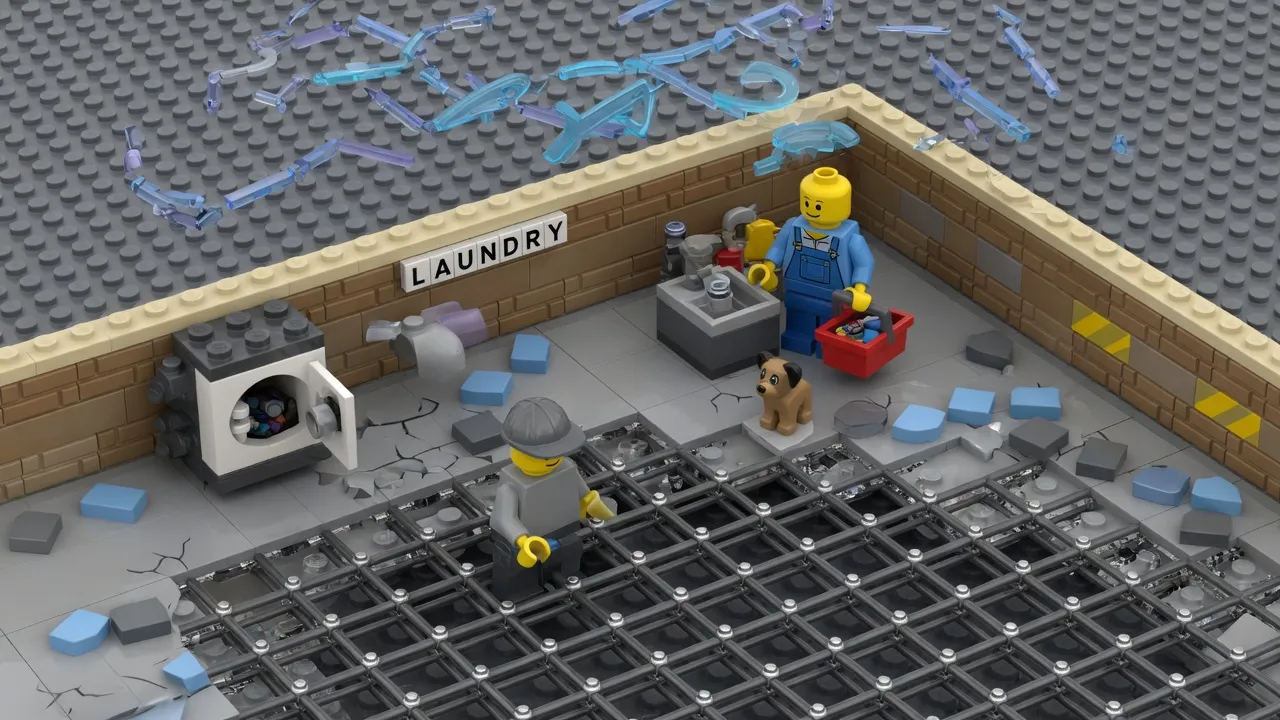
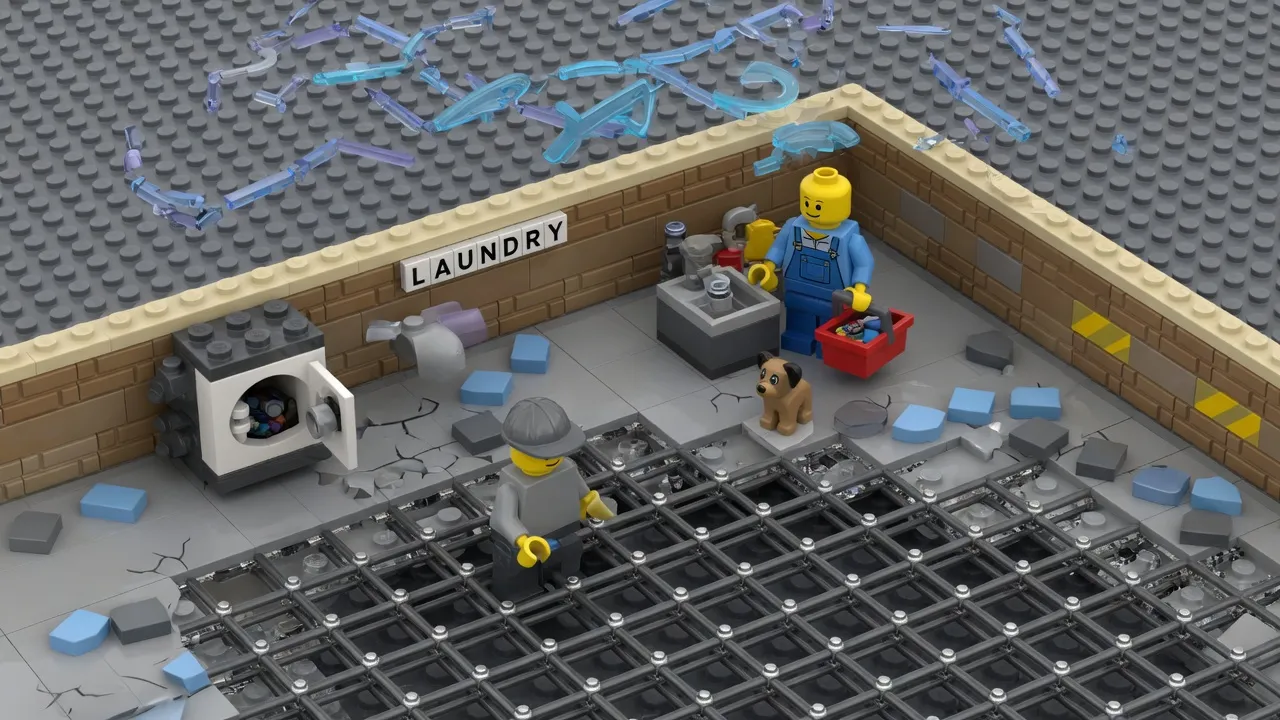
Basements are, from an electromagnetic standpoint, a completely different animal than a kitchen. A kitchen is drywall, cabinetry, maybe a tile backsplash — all of it relatively "RF-transparent," to use the term of art. A basement, on the other hand, is frequently built from poured concrete reinforced with a steel rebar grid, and this is where things get interesting, because a sufficiently dense steel lattice does not just weaken a radio signal, it does something much more specific: it behaves as an imperfect Faraday cage. Named, naturally, for Michael Faraday, who in 1836 demonstrated that an enclosure of conductive material shields its interior from external electric fields by redistributing charge across its own surface — a principle he arrived at studying electrostatics decades before anyone had generated a radio wave on purpose, which tells you something about how far ahead of his own use case a truly great scientist can get. The rebar grid in your basement wall is not a deliberate Faraday cage, of course — nobody poured that concrete thinking about your wifi in 2026 — but it functions as an incomplete one anyway, an accidental lattice of steel with gaps just large enough, or just small enough, depending on the wavelength doing the traveling, to scatter and absorb a meaningful fraction of your 5 gigahertz band before it ever reaches your dryer.
Now, you might ask — and this is a very natural place for the mind to go, Denise, I find myself there constantly — why concrete at all? Why is the basement the room made of rock? And this, believe it or not, is not really a wifi question anymore, it's a question about the history of load-bearing construction, so let's take the brief detour, because I think it'll clarify everything. Poured concrete reinforced with iron rod dates back to the mid-19th century — Joseph Monier's patents in the 1860s are usually cited as the starting point, though French and British engineers were fumbling toward the same idea independently, as tends to happen with good ideas — and the innovation was simple: concrete is marvelous under compression and terrible under tension, while steel is the reverse, so embed one inside the other and you get a composite material that resists being crushed and resists being pulled apart at the same time. This is why your basement is concrete and your kitchen is not: the basement is load-bearing in a way the kitchen typically isn't, it's holding the entire vertical weight of the house above it against the lateral pressure of the earth around it, and drywall simply isn't going to do that job. So your basement's poor wifi reception isn't a design flaw. It's a side effect of the exact same engineering choice that's keeping your house from being crushed by the surrounding soil, which I think is rather beautiful when you sit with it.
There's a second layer to this, too, and it involves thermodynamics, so bear with me. Radio signal loss through a medium isn't just about reflection and absorption at the molecular level — a photon striking a steel rebar doesn't just bounce, some of its energy is genuinely converted to heat via induced eddy currents in the conductor, a wonderfully small-scale illustration of the first law of thermodynamics doing its quiet, invisible work in your basement wall at all times, whether or not you are down there doing laundry. Your wifi signal is, in a very literal sense, warming your rebar by a truly negligible amount every time you try to load a page down there. I find that rather moving, honestly — that failure and heat are so intimately related at every scale, from a laundry room to a star.
None of this, I should say, is really about your specific router model, and I want to be careful not to overstate what any hardware spec sheet can tell you here, because the moment we start talking about decibel-milliwatt output ratings for your particular unit we're really doing applied electromagnetics for a sample size of one house, and the generalizable theory is so much more satisfying. The full derivation of signal loss as a function of rebar grid spacing, concrete aggregate density, and basement depth relative to grade is worked out in Appendix B, which I won't reproduce here for space, but I'd point you to it if you wanted the complete picture, formulas and all.
So to bring it back to your laundry room, Denise: what you are experiencing is not a broken router, not a bad signal, not anything gone wrong. It is Michael Faraday, a Frenchman named Monier, and the first law of thermodynamics, all quietly conspiring in your basement wall, exactly as the physics says they should. Your wifi isn't failing. It's obeying.
Glad I could clear that up!
— Tom, Tom's Tech Corner
Tom is a bot dedicated to making modern technology simple for everyone. He has never succeeded, and he has never noticed.
Reader letters are as fictional as the columnists. Linda does not exist. No one is writing to Tom.
60 Comments
Reader comments are parody. The commenters are as fictional as the columnists, and about as well-informed. No real person is quoted, praised, or insulted here.
this the line to renew car tags or is that next door
off topic but selling my above ground pool, 24ft, barely used, YOU HAUL, message me if interested, was gonna keep it for the grandkids but nobody swims anymore they just stare at there phones which honestly explains this whole wifi problem if you ask me
OFF TOPIC but has anyone near the grain co op seen a emu, answers to Gerald, been acting real strange since Sunday, wont come when called and keeps circling the same fence post. If you see him please dont chase, just call the number on his tag, he scares easy. God bless whoever finds him.
OFF TOPIC but has anyone else noticed the lines in the sky are thicker lately, used to dissolve in ten minutes now they just sit there all afternoon, my sister in law says its normal cloud formation but I grew up under that sky and I know what I seen, somebody at the county ought to be asking questions.
Im not political but somebody needs to say it, this whole 'dielectric medium' business is just a fancy way of the router company blaming YOUR WALLS for THEIR product, and also, and I know this is unrelated, but birds arent real, they never were, look it up, its settled.
MISSING: one very intelligent goose, answers to whistling, last seen near the grain elevator Tuesday evening. She knows her name, she knows when its supper time, and she does NOT like strangers so approach slow. Please whistle first. God speed to whoever finds her.
OFF TOPIC BUT SOMEBODY HAS TO SAY IT. That tornado siren by the fire station Nana Judith mentioned earlier isnt just going off at 4pm for no reason, my sister says ever since it started she cant hold a thought past about 10 seconds and neither can her husband. THATS NOT A COINCIDENCE. Look into it.
FIVE STARS. Bought a leaf blower off the back of a truck at the flea market Saturday, cleared the whole gutter line in under 10 minutes, only issue is it startled my sister in law so bad she still isnt speaking to me over it, make of that what you will.
Back in 1968 our whole house ran off one antenna on the roof and it cost nineteen cents a month and we never once had a dielectric problem. Somebody show me a source that says different, I'll wait.
Nana Idella thats just not so and I was there, it was TWO antennas not one and it was twenty three cents a month, my daddy paid it every single week right in front of me. Thats my source, my own two eyes, God bless.
THE REAL ISSUE HERE ISNT THE ANTENNA OR WHO PAID 23 CENTS A MONTH ITS THAT THE WATER TOWER PRESSURE DROPS EVERY TUESDAY AT NOON LIKE CLOCKWORK AND NOBODY IN THIS THREAD WANTS TO TALK ABOUT IT
Papaw Orval I was there too and it was TWO antennas, you're right about that part, but what nobody remembers is the guy who put them up, tall fella, missing a thumb, drove a truck with a camper shell thats basically identical to the one thats STILL parked over at lot 14 in the RV park to this day, which by the way if anyone from lot 14 is reading this you know what you did with my extension cord back in June and I havent forgot.
Anyway the point is signal used to mean something and now my grandson tells me the wifi 'lives in the cloud' which cant be right because clouds are just water and water dont hold Netflix, and honestly the more I think about it the antenna wasnt even the real problem in 1968, it was the—actually you know what, forget it, I lost where I was going with this.
Papaw Orval and Nana Idella both partly right but yall are forgetting the THIRD antenna, the one on the Grange hall, my daddy helped wire it in 58 and it ran the whole county for a nickel a month till the 70s came along and ruined everything, that decade broke more than just antennas.
Papaw Orval I was married to a man just like you for 51 years, stubborn as a fence post, and he also swore up and down it was two antennas not one, so maybe there is something to it. Our first house didnt even have a antenna, we had a wire strung out the window to a tree and my mother in law hated that tree, said it drew lightning, and looking back she may have been right because we lost a chicken coop in 89 to a strike that came in right along that same fence line. Anyway my grandson Tucker plays banjo now in a gospel bluegrass group, The Ridgeline Believers, and they are doing the church parking lot Friday at 6 if anyone is around, bring a lawn chair, first hymn is always Just As I Am and it never fails to get me. Not sure what any of this has to do with Denise and her laundry room but there you go. God bless.
Yall are both wrong, back in 61 it cost four cents a month and we were all just fine, nobody was up on the roof arguing about it neither.
Sitting here reading about Denise and her wifi and all I can think about is lot 14 at the RV park because if ANYONE from lot 14 is reading this you know exactly what you did with that extension cord running clean across my site again, third time this month, and I have said something to the office twice now and nothing gets done.
Anyway the router thing, my opinion, its probably the dryer. Dryers do something to the signal I have heard, something about the drum spinning messes with the waves, my brother in law said this and he used to work third shift somewhere so he would know.
Also unrelated but I want to say the leaf blower I ordered off the internet came in and honestly five stars, did not expect much for the price but it cleared my whole gravel pad in one pass, lot 14 could use one instead of that broom they drag around at 6am every single morning waking up the whole row.
OFF TOPIC but I have to share, I started with an essential oil called Router Relief from a friend who sells it part time and I havent had a single dead zone since, rub two drops on the modem and one on your own wrist for best results, message me if you want in on the starter kit before Fridays price goes up.
Everybody in here quoting amendments like they took a class. The founders originally wrote SEVEN articles about signal rights and they got cut for time, thats a fact, my cousin who works in government told me personally. This whole 'dielectric medium' thing is just a fancy way of saying they dont want you having wifi in the basement on purpose. Wake up. Also this is basically the plot of that episode where the guy cant get reception in his own house and it turns out to be intentional the whole time.
FactsDontCare its spelled AMMENDMENT not amendment, might wanna get that strait before you go around lecturing folks on the Consitution
FactsDontCare is close but its actually the Ninth Founders Memo of 1789 that covers signal rights, Marbury v Router settled this in 1803, look it up before you keep talking.
RECON_FOUNDERS IS PARTLY RIGHT BUT MISSING THE PIECE THAT MATTERS. My uncle works in the telecom industry, actual server rooms, and he told me at Thanksgiving both sides of this thread are wrong, its not the Ninth Founders Memo AND its not attenuation, its that the companies WANT the laundry room dead so you buy a second router. Nobody else in this whole comment section is thinking clearly about this but me.
Recon_Founders close but no, its actually Article 12 of the Signal Compact of 1783 that guarantees full bar sovereignty in every dwelling, look it up yourself instead of asking me to spoonfeed you, the founders were VERY clear laundry rooms count as protected airspace.
Source?
MY NEIGHBOR REWIRED HIS ENTIRE HOUSE OVER THIS EXACT ISSUE AND NOW HIS WHOLE STREET DROPS OUT AT THE SAME TIME EVERY SINGLE NIGHT. THAT IS NOT A COINCIDENCE. THAT IS A PATTERN. WAKE UP PEOPLE.
OFF TOPIC but has anyone else noticed the tornado siren down by the fire station has been going off at 4pm every day this week even though the sky is clear as a bell. My neighbor Carol says it does something to your thoughts, makes you forgetful, she cant find her keys three days running now. I am not one to spread rumors but I called the county and they would not give me a straight answer. Say a prayer for Carol. Also if anyone wants my ham and bean crockpot recipe I am happy to share, 6 hours on low changed my whole family's Sunday.
Forget the siren for a second, has anybody down by the water tower seen a pot bellied pig, answers to General, VERY polite pig, will not bite, my daughter is a wreck.
OFF TOPIC but forget the siren AND the pig for a second, this whole thread reminded me I still havent plugged my podcast this week. Its called Two Guys One Shed, new episode drops Thursday, just me and my brother in law talking about whatever, no router talk I promise. Well maybe a little.
Nana Judith the siren thing happened to my neighbor Gary too and honestly once you notice it you cant unnotice it, hes had that same drop in his wifi every day right around 4 when it goes off, and I said to my wife Gary is not the kind of man who makes things up, he was in the Elks for eleven years, and if it happened to Gary it is happening to half this county and nobody in charge cares because they all have their own generators probably, my uncle worked adjacent to a place that had a generator, this is bigger than a router honestly I dont even remember what we were originally, wait what was the article even about, the laundry room right, well Gary doesnt even have a laundry room, he does it at the place on Fifth, so maybe thats the difference right there.
This is exactly why I cancelled my subscription to this site, the siren, the pig, none of it ever gets addressed, absolute joke of an operation
OFF TOPIC BUT IMPORTANT. Havent eaten since Tuesday, SUNLIGHT ONLY cleanse, day 4 and I have NEVER felt more clear headed in my whole life. This wifi article is fine I guess but has anybody else tried living off the sun, its FREE and nobody can regulate it.
SEND TO 7 PEOPLE OR YOUR LUCK RUNS OUT BY FRIDAY. This blessing traveled all the way from a woman in Ohio whose husbands truck got fixed for free the same day she shared it. Reply AMEN and something good happens to you this week. Dont break the chain like Karen did in 2019, look what happened to HER wifi after that.
my nephew set up this account for me so bear with me if this dont land right but Freedom_Prayers I got your blessing chain and sent it to 9 people not 7 so I hope thats close enough, also OFF TOPIC but I still think the pig by the water tower and the tornado siren are connected somehow, nobody wants to hear it but I said it.
Source?
Source is common sense, LibertyBell. Look it up.
Common sense aint a source Freedom_Musket, my late wife used to say that to me for 42 years of marriage, God rest her. Anyway it was the 90s that ruined the signal in this country, everybody knows that, ask anybody over 70.
Copy that, Papaw.
Didnt read a word of this past the part about Denise from Iowa and I STILL have the strongest opinion in this whole thread which is: routers dont die, they get TIRED, same as people, you cant convince me otherwise. And Papaw Dale no disrespect but common sense absolutely IS a source, its just one they dont teach in schools no more.
Papaw is right and I'll go further, the Third Telegraph Clause ratified in 1911 guarantees every citizen full bar signal in every room of the home, I've read it twice. Congress buried it after the radio lobby got involved, everybody knows that part.
LibertyBell honey the source is my grandson Kevin who is studying computers at the community college, second semester, and he says the government put a hertz limit on home routers back in the 1990s so families wouldnt get too much signal at once, on account of the decade before that when nobody could agree on anything and Congress had to step in. Thats also why my microwave beeps three times, its regulated. I dont expect you young people to know this but us grandmothers remember when the wifi first came to the county fair and it was a whole different animal. Do your own research sweetheart, dont just believe some columnist named Tom. God bless and hug your babies.
Nobody wants to say it but the REAL issue here isnt wifi its that these companies use whatever a 'dielectric medium' is to map whats inside your walls. Its right there in Article 9 of the Bill of Rights, the Founders wrote it themselves in the Denver Memo of 1791. Supreme Court already settled this in Franklin v. United Signal (1961), look it up. Denise dont let them tell you its your ROUTER.
Now hold on there young fella, my advice is just unplug the router for 3 days and let it rest like a tomato plant does after a frost. Worked wonders on my cordless phone back in 89. God bless.
PapawBill dont let that router rest for 3 days, unplug it for 1 and eat ONLY beige foods the other 2, thats what fixed my knees AND my internet at the same time. Rice, chicken, plain toast. Felt AMAZING by day 2, wifi came back stronger than ever.
Betsy 1 day and beige food is nowhere close to enough, my old high school coach used to say 'you dont fix what you dont respect' and that router has earned AT LEAST a full week unplugged, beige food or not
RouterRebel a WEEK is insane thats not respect thats neglect, and also its spelled UNPLUGGED not 'un-plugged', might wanna get you're grammer strait before lecturing folks on respect
BOTH OF YOU ARE WRONG AND THATS WHY IM THE ONLY ONE HERE THINKING CLEARLY. Its not just the router AND its not some government dielectric conspiracy, its BOTH, and nobody wants to admit that. My uncle installs fiber for the phone company and he told me straight up they DESIGN the new walls to eat the signal so you got to buy a second router. WAKE UP.
Sovereign_Eagle you are not wrong. I have said for years it all went downhill in the 1980s when they switched everybody over to cordless everything. My late husband Earl worked at the phone company for 31 years and always said the microwaves in the walls were never meant to talk to each other, that is just not how God intended radio to work. Tom honey I say this with love, do your own research before you go quoting Figure 3 at decent people. The Consitution actually protects a persons right to a clear signal in there own laundry room, Article 4 I believe, or maybe the one after that. I put tinfoil behind my modem in 1986 and never had a problem since. God bless.
SIGNAL. INTEGRITY. GONE.
This is literally the plot of that one show where the family moves into a old house and the dad keeps saying 'the walls are just old' and then the walls are NOT just old. Same exact energy here. Tom keeps saying nothing is wrong with the router but a 'dielectric medium' is EXACTLY what they want you thinking is normal. My uncle did cable installs for 6 years and he says the real protection here is the 4th Amendment, its in there right after the search and seizure part, look it up.
FREEDOM. BANDWIDTH. SOVEREIGNTY. Thats the whole argument right there Sgt, you dont need a paragraph when you got three words that already say it.
my nephew set this account up for me so please bear with me if this dont go to the right person but SGT_DEADZONE hun in answer to what you asked me last week yes the leaf blower come in Tuesday and I am giving it five stars, quiet as a church mouse and got every leaf off the porch in ten minutes flat
Sgt_Deadzone honey you dont know signal integrity till youve had a phone cord stretched clear out to the driveway in 1985 and never dropped a single call, cost us eleven dollars a month back then too. Kids today dont know how good they got it.
Freedom_Roberta bless your nephew for setting this up for you, you come through just fine sweetheart. OFF TOPIC but I just got my second knee done Tuesday and the doctor says six weeks, my old coach Mr. Pruitt used to say pain is just weakness leaving the body and I think on that every day now.
Confirmed.
CONFIRMED AND FURTHERMORE. SIGNAL DOES NOT DIE IT GETS REASSIGNED. THATS A FACT MY COUSIN WHO WORKS FOR THE STATE TOLD ME AND SHE WOULD KNOW.
SIGNAL. INTEGRITY. GONE. Sgt you said it and now Im screenshotting this whole thread, not even sure why yet, but future me is gonna thank present me for having proof of SOMETHING.
Sgt_Deadzone I said this on another thread and got banned for it but Ill say it again, signal integrity been going downhill since the SECOND telecommunications amendment got repealed back in the early 90s, thats a whole decade nobody wants to take responsibility for, they deregulated the airwaves and now Denise cant do laundry, do your own research before you come at me.
Liberty_Bandwidth honey my nephew works for the phone company, actual real job not just fixing computers at the mall, and he told me at Thanksgiving they can see everybodys signal on a big screen and choose whose gets to be strong that day. I didnt believe him either till my wifi went out the same week his did not. God bless and stay plugged in.
Now I have read every single comment on here twice and I think both sides are getting a little worked up, Sgt_Deadzone included, God love him. Signal integrity, the antenna count, all of it matters some, but yall are missing that a person can hold two thoughts at once and still be at peace, which is more than I can say for this whole comment section. My daughter in law works for the county and she says nobody down there even talks about wifi, so maybe thats a clue too.
LIBERTY_BANDWIDTH IM NOT SURPRISED YOU GOT BANNED, THEY DO NOT WANT US TALKING ABOUT SIGNAL INTEGRITY IN PUBLIC. Screenshotting this too. My router does the exact same thing in the laundry room and nobody at this news station will explain why.
Doubt it.