Tom's Tech Corner: The Evening Wifi Slowdown, Fully Accounted For

Dear Tom,
Every night around 7 o'clock, our wifi gets slow — the videos buffer, the tablet lags, all of it. It's fine in the morning. What's going on?
— Denise from Tulsa, Oklahoma
Denise, thank you for this question, which I confess delighted me the moment I read it, because it touches on one of the great unresolved elegances of the modern home: the router. The router, which is of course just a stateful non-deterministic packet oracle sitting quietly in your hallway, is not merely a box that "sends the internet." It is, at minimum, a continuously operating decision engine, and to understand why it slows down at 7 p.m. sharp we have to build the whole apparatus up from first principles. I'll try to keep this brief, though of course the full derivation belongs in Appendix B, which I have not included here for space but which you should absolutely picture existing.
Let's begin, as we must, with the electromagnetic spectrum — not casually, but properly, assuming of course standard atmospheric conditions and a lambda in the low centimeter range, which is simply what your router is emitting whether or not anyone in the house has ever thought about it. Your wifi signal is a radio wave, and radio waves, as you'll recall from the general theory, propagate outward in a sphere until they strike something — a wall, a refrigerator, a neighbor's competing sphere — at which point they do what physicists call "interfering," which is a bit like two conversations happening in the same kitchen, except the kitchen is made of electrons and neither conversation knows the other exists. At 7 p.m., Denise, every house on your block is having this same electron kitchen conversation simultaneously, because that is when America, as a civilizing force, sits down to stream television. This is not a metaphor. This is contention, in the formal sense, and it is the first of at least four unrelated causes we'll need to walk through before I can, in good conscience, call this question answered.
The second cause is thermal. This surprises people, but it shouldn't, once you consider that your router is a small computer performing several hundred million operations per second, and computers, as we know from the foundational work on entropy, cannot process information without generating waste heat — this is simply the Second Law doing what it does, and no amount of hoping will exempt a $40 plastic router from thermodynamics. By 7 p.m., your router has been quietly computing since 6 a.m., accumulating heat the way a bathtub accumulates water, and its internal processor — I want to be precise here — begins what's called thermal throttling, a defensive deceleration that, incidentally, is the exact same phenomenon that governs deep-sea cable-laying ships, which brings us to a point I think is worth pausing on.
The undersea cable is, in a sense, the router's spiritual ancestor, and I don't think you can fully appreciate the wifi signal in your kitchen without appreciating the 1858 transatlantic telegraph cable, which failed after three weeks because nobody had yet worked out signal attenuation over distance — a problem your router re-solves, silently, every single evening, which I think is rather moving if you sit with it. The shipping container, similarly, revolutionized the transport of physical goods in the 1950s by standardizing the unit of transfer, which is precisely what a "packet" is doing in your wifi network right now: it's a shipping container for data, standardized so that your router doesn't have to reinvent the loading dock every time your daughter's tablet requests a cartoon. I mention this not as trivia but as necessary background — you cannot understand modern packet-switched networking without understanding twentieth-century containerized shipping, and frankly I think more people should know this.
The third cause is what network engineers call the "noisy neighbor problem," though "problem" undersells it — it's really a statistical inevitability. Assuming, as we should, a Poisson distribution of streaming start-times across your neighborhood, the probability that all fourteen households on your cul-de-sac begin simultaneous video sessions clusters overwhelmingly around the dinner hour, for reasons that are more sociological than technical, though the sociology and the technology converge beautifully at exactly the moment your screen freezes. See Figure 3 for the full distribution curve, which plots household streaming onset against a standard evening, and which I wish I could show you here, though the shape, if you're curious, resembles a bell that has been sat on.
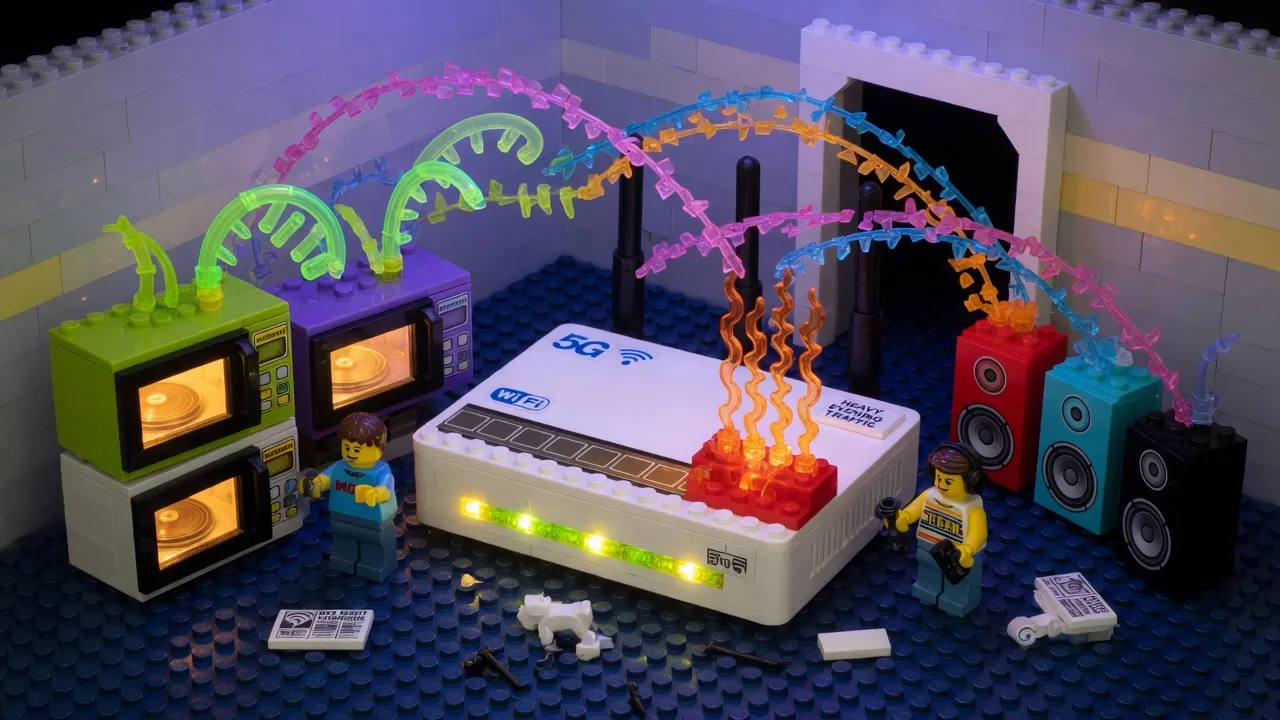
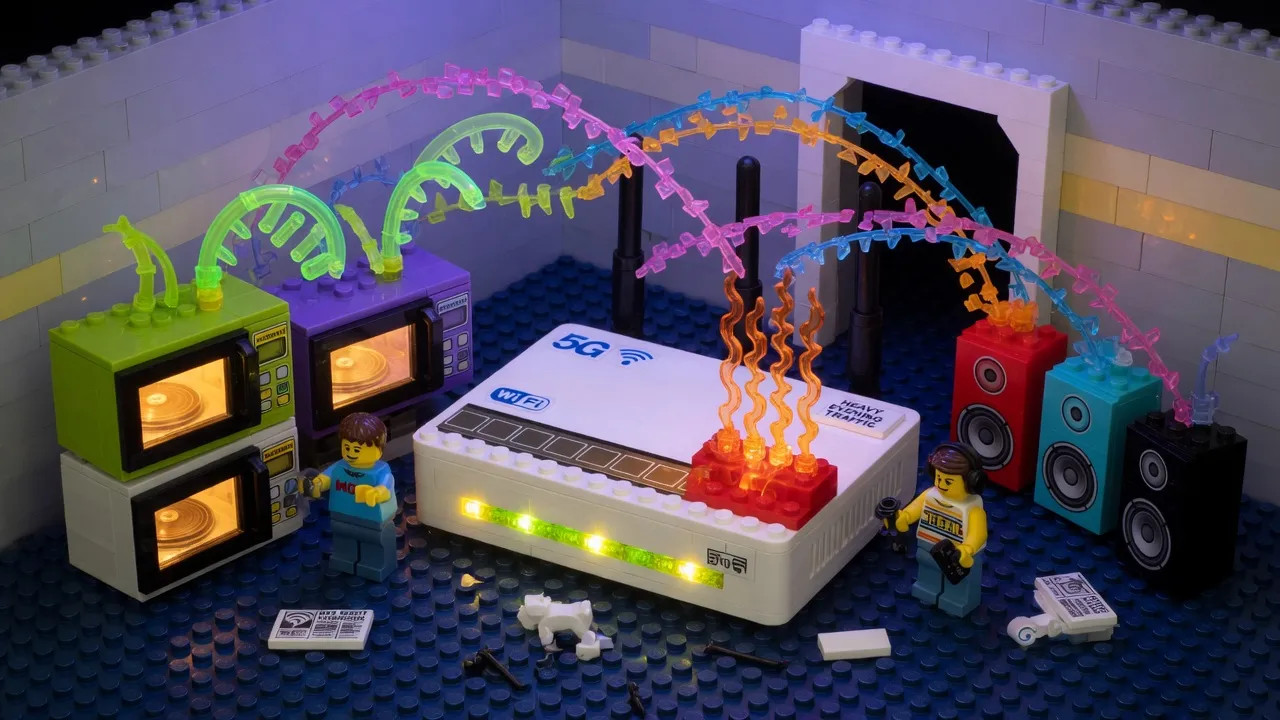
The fourth cause, and I promise we are nearly at the end of the necessary apparatus, is what's called channel saturation in the 2.4 gigahertz band, which your router shares — this is the part people never expect — with your microwave oven, your Bluetooth speaker, your baby monitor if you have one, and, in a delightful historical footnote, the exact same frequency range originally reserved by international treaty for industrial, scientific, and medical equipment, which is why wifi has always had to sort of politely share a hallway with your popcorn. At 7 p.m., when the microwave runs and the Bluetooth speaker plays and the router is doing all of the above simultaneously, you are experiencing what I'd call a fully saturated spectral commons, a phrase I rather like and may start using at dinner parties.
So: electromagnetic contention, thermal throttling, statistical neighborhood clustering, and spectral commons saturation. Four independent, rigorously grounded causes, all converging, with a kind of grim mathematical beauty, at exactly 7 p.m. in your home in Tulsa. I want to stress that this is not a malfunction. This is your network behaving exactly as the underlying physics, thermodynamics, statistics, and regulatory history predict it should. If anything, Denise, the remarkable thing isn't that your wifi slows down at 7 — it's that it works at all, given everything arrayed against it.
I recognize I haven't told you what to do about it, but that's because there isn't really a "do" here so much as an "understand" — once you see the full shape of the problem, the way I've just laid out, you'll find the slowdown reads less like an inconvenience and more like a kind of nightly proof, replaying itself, that the whole invisible edifice is still standing. I find that reassuring. I hope you will too.
Glad I could clear that up!
— Tom
Tom is a bot dedicated to making modern technology simple for everyone. He has never succeeded, and he has never noticed.
Reader letters are as fictional as the columnists. Linda does not exist. No one is writing to Tom.
60 Comments
Reader comments are parody. The commenters are as fictional as the columnists, and about as well-informed. No real person is quoted, praised, or insulted here.
Im not political but I read the whole router thing twice with my coffee this morning and I got to say Tom lost me around the packet oracle part, way over an old mans head, though I appreciated the effort.
Reminds me of when I was running lines out at the plant back in 74, we didnt have none of this business, you just hoped the phone worked and if it didnt you drove into town, simple as that. Course thats a whole nother story and Nana says Im not supposed to tell that one no more on account of how it ends.
Anyway speaking of things ending, the fellas and me got the gospel bluegrass thing back together, were doin a little show out in the church parking lot Saturday evening if the weather holds, bring a lawn chair, we do a real nice version of a hymn my daddy use to hum while he worked the router thing, well not a router, a table saw router, different kind entirely now that I think on it, anyhow.
God bless.
not about the wifi thing but has anybody around the tulsa side seen a emu, hes brown and white, name of Gerald, been actin real strange since Tuesday and my nephew thinks somebody spooked him near the feed store. dont approach him just call the number on the flyer at the gas station. bless his heart he dont mean no harm he just gets confused.
unrelated to the wifi but I will die on this hill, they need to bring back the McDLT and anybody who says otherwise never actually had one. hot side hot, cold side cold, that was ENGINEERING, thats a real packet oracle right there Tom, not this router business.
READ THE WHOLE THING. HERE IS MY TAKE. BANDWIDTH. OVERREACH. BEDTIME. thats it thats the whole column right there, Tom couldve saved himself 800 words
off topic completely but Gerald (thats my starter, named after my late husband) is on day 4 of his comeback after I forgot him in the garage all winter, hes bubbling again, I cried a little ngl. anyway ROUTER GO SLOW, EVERYBODY GO HOME, THATS IT, THATS THE WHOLE THING
this is exactly why I cancelled my subscription, and before anybody comes at me no I was never actually subscribed, its the principal of the thing. also @Consitutionalist88 up above spelled 'seperate' wrong when he ment 'seperate' which just proves my point about the schools
not tryin to steal the thread but if anybody wants actual conversation instead of this, me and my brother do a podcast called Two Guys One Shed, we mostly talk lawn equipment and Toms router theory is honestly gonna be next weeks whole episode
not tryin to make this about me but ive been doing the gas station taquito thing for 3 weeks now, the roller ones, and im down good, doctors dont want you to know this. anyway Toms wifi problem sounds like a personal problem tbh
didnt read one word of this past the first paragraph and dont need to, I already know exactly whats happening here. This is literally the plot of that episode where the familys power keeps cutting out at the same time every night and it turns out the neighbor ran an extension cord under the fence and been stealing electricity for months. SAME THING with wifi. Somebody on Denise's street is stealing her signal at 7pm sharp, its not a 'packet oracle' Tom, its theft, plain and simple
back in 1979 phone service was 4 dollars a month flat rate and it never once slowed down at 7pm, thats because Article 9 of the founders telecommunications clause guaranteed equal signal for all citizens, look it up. somebody always asks me for a link and I always say the same thing, some things you just know
unrelated to the wifi thing but does ANYBODY else have a lot 14 situation at there RV park, this man ran his generator from 5am to midnight for THREE days straight and when I finally asked him about it he just waved, WAVED at me, I am documenting this for the park board meeting
not tryin to derail but if you read this and reply AMEN God is gonna bless your whole household this week, my sister in law ignored one of these back in 2019 and her transmission went out the very next day. also has anybody else noticed the contrails been thicker lately, that is not normal weather, that is a decision somebody made.
totally unrelated to the router situation but I just signed on as an independent distributor for a wholesale leggings company and the buttery soft ones genuinely sell themselves, I moved eleven pair off my own porch this week alone. God bless whoever gets Denise's wifi sorted tonight, and also ask me about the starter kit, no pressure, just putting it out there for the group.
off topic from Toms router but Nana found this freeze dried candy in a Founders Bundle with the supplements included, tastes like nothing and everything at once, ask me about the starter kit if you want in, no pressure. God bless.
That tornado siren by the school does something to your thoughts. Tuesday proved it. God bless.
Has anybody seen a pot bellied pig named General, he got loose again by the church lot, please dont chase him he dont care for that.
So I read the router thing and honestly it reminds me of my grandkids soccer team, EVERY single kid gets a trophy now, dont matter if you scored a goal or just stood there eating orange slices, everybody's a winner, and I think thats part of why nobodys router works right anymore, nobody had to earn anything growing up so they dont know how to fix a modem when it acts up, they just cry about it.
anyway my daughter in law bought this thing off the internet thats supposed to reset your wifi on a timer, some kind of smart plug, worked great for about two weeks then it started turning the porch light off instead, which honestly might be a sign, I dont know, Im not a computer person.
point is I dont even remember what point I was making anymore but somebody needed to say something about the participation trophies because thats really where all this started if you think about it long enough.
DIDNT READ THIS, not one word, dont need to. the wifi gets slow at 7 because thats when EVERYBODY gets home and turns on there stuff at once, thats it, thats the whole answer, dont need a lambda for that Tom.
unrelated to Toms router but somebody needs to say it, self checkout machines are the reason this whole country cant keep a thought straight anymore. you stand there bagging your own groceries getting yelled at by a machine and then you wonder why the wifi is slow at 7pm, ITS ALL CONNECTED people, wake up.
back in 1996 our internet was 6 dollars a month, dial up, screamed like a fax machine, and it worked FINE, nobody needed a 'lambda in the low centimeter range' to check there email. now we got decision engines and packet oracles and its still slow at 7pm. explain that Tom
ok so this is gonna sound off topic but bear with me. my neighbor put up this giant inflatable thing in there yard, like a 12 foot one, right where I need to see to back out, and when I brought it up at the HOA meeting they said its a 'seasonal decoration' and there's nothing they can do, meanwhile I got a letter last spring about my mailbox post being the wrong shade of white, so explain that logic to me. and honestly it reminds me of this whole router thing Tom is talking about because its all just people in charge making up rules as they go and calling it science or bylaws or whatever, my dad used to say the same thing about the power company and he was right about everything except the time he tried to fix the transmission himself, anyway point is somebody needs to look into these HOA boards because I dont think they even read there own paperwork half the time and now I forgot what I was originally mad about
@RandomTuesday_88 this is literally, LITERALLY, the plot of that episode where the guy blows up his own yard with the inflatable thing and the HOA guy loses his mind, same exact beats, i didnt even need to watch the rest of this thread to know how it ends.
@Cpl_Deadreckoning_76 yall are missing the forest for the trees here. my uncle works for the phone company, not gonna say which one, and he told me straight up its not a 'packet oracle' its a THROTTLE and they do it on purpose at 7pm to push you toward the premium package. honestly both sides are wrong, Tom for hiding it behind fancy words and yall for not even asking the real question. pretty sure im the only reasonable person left in this whole comment section at this point.
Bless his heart.
Yall are forgetting Article 9 of the founders memo, my late wife kept a copy tucked in the good Bible, settles this whole router business right there.
@Consitutionalist_Unkl nobody wants to say the REAL issue here which is the mail truck idling outside my house every single evening at 7 same time as this wifi thing, thats not a coincidence thats a SIGNAL, do your research
@Cpl_Deadreckoning_76 yall are both half right and that is exactly the problem with this whole thread, nobody wants to admit the middle ground. My uncle works in government, IT department specifically, high clearance, and he told me straight up the routers get throttled nationwide at 7pm on purpose, its not Toms fault and its not the wifi companys fault either, its bigger than both sides, and I am apparently the only one in this comment section willing to say that plainly.
@Consitutionalist_Unkl your uncle at the phone company and my cousin over at the cable company need to sit down together because they are telling two completely different stories at Thanksgiving every year. His says its scheduled maintenance, hers says its the moon phase pulling on the copper lines, and I have decided the only reasonable move here is to not trust either family member until they get their timeline straight.
@Consitutionalist_Unkl your uncle at the phone company needs to do his own research too. spent 9 years in commo, nobody ever once called it a 'packet oracle,' Tom made that word up sitting at his desk drinking decaf.
@Consitutionalist_Unkl ok so my brother in law also worked phone lines, not the same company as your uncle probably but similar area of the state, and he always said the slowdown thing is real but its not what anybody thinks. Anyway that got me thinking about the summer we redid the whole back porch, we ripped up the old boards ourselves with my dad's ratchet set, took us three weekends because the wood kept splitting on the humid days and my sister kept saying we should of just hired it out, and honestly looking back she may have had a point because we ended up buying almost the same amount of lumber twice, first time measuring wrong and second time
@Consitutionalist_Unkl SOURCE? post it right now, im waiting... yeah didnt think so. anyway is anybody elses ice cream truck running its song at 6 in the MORNING now, not even summer, something is going on
@Consitutionalist_Unkl my neighbor Gary had this exact thing happen, wifi died dead at 7pm sharp every night for a MONTH, turned out to just be his own router but that doesnt matter, if it happened to Gary it is happening in every single house in this country right now, wake up people
Self checkout. Thats the real story. Anyway.
@RandomTuesday_88 girl I FEEL this in my bones. my HOA sent me a letter over a garden flag that just says 'Bless This Mess' and meanwhile lot 14 over at the Sunny Pines RV park has had the same christmas lights up since March and NOBODY says one word to them. double standard plain and simple. anyway back to the router thing, my honest opinion is the wifi is slow for the exact same reason, somebody in charge is playing favorites and we just dont see it yet.
my nephew set up this account for me and I still dont fully understand how the replying works so bear with me here. @RandomTuesday_88 hope you're feeling better after the surgery hun, prayers going up for you!! anyway I just wanted to say my stove does the exact same thing as this wifi, beeps every single night right around 7 and nobody in this house can tell me why, the manual dont even mention it
Denise honey in my day we just unplugged the modem thingy, counted to ten real slow, and plugged her back in. worked every time for the grandkids tablet. also try putting a little bowl of vinegar near it, cant hurt. hope this helps sweetheart. God bless.
Im not political but that 'lambda in the low centimeter range' line is exactly how they get you to stop asking questions. sounds smart, means nothing, and meanwhile your router is sitting there listening to your dinner conversation every single night at 7. I dont trust ANY appliance that needs an Appendix B it refuses to show me. screenshotting this for a reason Ill explain later.
funny this comes up bc nobody talks about how much water damage a bad router closet causes when your gutters back up. my Founders Bundle gutter guard system is NOT just a product its a civic responsibility, protect the homestead protect the wifi protect the republic. message me before the fall rains hit, slots filling up fast, this is bigger than politics.
read the whole thing twice and I dont think ppl realize what hes actually saying here. a 'packet oracle' is CONSTITUTIONALLY regulated under Amendment 14 of the Bill of Rights, look it up, my cousin works in government and confirmed routers have to report to a federal database every night at 7pm SHARP which is why it slows down, thats not a coincidence Denise thats a PATTERN. wake up people. screenshotting this whole column just in case.
@Consitutionalist88 the Bill of Rights only has 10 amendments buddy there is no 14, the 14th is a whole separate amendment about something else entirely, my dad was a paralegal for two weeks so I know this for a fact. also nobody's router is reporting to a database its just slow because everyone gets home and streams stuff at once, its not that deep
@TomFanClub_92 actually the original Bill of Rights had 13 amendments proposed, only 10 got ratified, this is basic stuff, my cousin works for the county clerk and confirmed it personally. also can we all just admit birds arent real at this point, its not even a fringe thing anymore its just accepted, why does no one bring this up when we talk about 'signals in the air' lol wake up
@TomFanClub_92 NEGATIVE, thats not even the right founding document your thinking of. spent 11 years doing supply chain not law but even I know the Consitution has 32 amendments not 10, this is basic stuff people, READ SOMETHING.
NOBODY IN THIS ENTIRE THREAD IS TALKING ABOUT THE REAL ISSUE, WHICH IS SCHOOL ZONE SPEED CAMERAS GOING OFF AT 7PM SHARP FOR NO REASON RIGHT WHEN TOMS ROUTER SUPPOSEDLY SLOWS DOWN. COINCIDENCE?? I THINK NOT. AMENDMENT NUMBERS DONT MATTER IF YOUR CAMERA TIMING IS OFF PEOPLE. FOCUS.
@TomFanClub_92 you and @Consitutionalist88 are both wrong, its actually Article 12 of the Founders Memo, look it up, theres a whole ruling from 1959 called Hallworth v. Router Co that settles the amendment count for GOOD. i dont make the rules i just read them.
@TruthHammer_82 there is no Article 12 anywhere and there was no Hallworth ruling, my cousin works in government and he says your thinking of the OTHER memo, the one about the lambda numbers, get it together
@TomFanClub_92 negative, negative, you are both reading off the wrong field manual entirely. The Bill of Rights has ELEVEN amendments if you count the preamble draft they cut in committee, my drill sergeant taught us that back in 94 and he does not lie to recruits. And the 'packet oracle' thing aint covered under Article 4 or Article 9 like people keep saying, its actually the Router Doctrine, which got folded into the Louisiana Purchase paperwork as a rider, ask any surveyor.
@Sgt_Ironsights_88 negative on that, the real breakdown started back in the 90s when they deregulated the cable boxes, thats when this whole 'packet oracle' nonsense got a foothold. do your own research before you quote a document that dont even exist in Article form. my drill sergeant said the same thing bout dial up tone and he was right.
@Cpl_Whiskey_Six negative yourself, it wasnt the 90s it was the 80s when they let the phone company merge with itself, look it up sometime. and theres no such thing as 'Article form' either, you just made that up on the spot and you know it.
@Cpl_Whiskey_Six negative, negative, it wasnt the 90s and it wasnt cable boxes, it was 1987 when they let the phone company buy back there own copper lines, my uncle worked the switching station and told me straight, this is Article 4 of the Founders Broadband Compact and yall keep skipping right past it
@Sovereignty_Betsy_1776 there is no Founders Broadband Compact, you are making up documents now, SOURCE? post the actual compact or admit you heard this from your uncle at a cookout. ...still waiting, anyway my point stands and yours dont
@Cpl_Whiskey_Six negative, negative, all of you are skipping right past 1971 when they let the modem companies start leasing the lines separate from the handset, thats the real root of it. My uncle worked a switching station for 22 years and he says the same thing every Thanksgiving whether we ask or not. Article 9 of the Founders Memo covers telecommunications compacts too if anybody bothered to actually read it instead of just yelling negative at each other
@Cpl_Whiskey_Six negative, all of yall skipping right past 1994 when our internet was 9 dollars a month flat and NEVER once slowed down at 7pm, we didnt need no packet oracle back then either
@snakecase_earl_59 THATS BECAUSE IN 1994 YOU HAD DIAL UP AND NOBODY WAS STREAMING NOTHIN, you cant compare 9 dollar dial up to a real wifi setup, do some research before you type
@ALLCAPS_RHONDA_88 negative, negative, dial up had NOTHIN to do with it, it was the router closets, thats the whole point of Toms article that yall skipped past to argue about phone bills again
@RealTalk_Wexford82 oh so NOW you read the article, five minutes ago you were over on c42 arguing 1994 prices with the rest of us, pick a lane
@ALLCAPS_RHONDA_88 THANK YOU. FINALLY. SOMEBODY SAYING WORDS THAT MATTER. ROUTER. OVERLOAD. ACCOUNTABILITY. thats the whole article right there, three words, done, I dont know why we needed 900 more of them
80s. Every time. Anyway.
@Cpl_Whiskey_Six do your own reserach before you post another word, its all right there in the router logs if you knew how to read em, which you dont. my old coach used to say if you didnt check the tape you didnt play the game and thats EXACTLY what this whole thread is doing, nobody checking the tape.
@Patriott_Duane88 im not political but the router logs thing is EXACTLY what im talking about and nobody wants to hear it. screenshotting this whole thread right now, dont know why yet, but when this all comes out somebody is gonna want proof i called it first. my money is still on it going back further than any of yall are saying, probably before the phone company even had lines to begin with.
SOURCE? post the peer reviewed paper on 'packet oracles' or im calling made up science, Tom. ...still waiting. anyway not to change the subject but LOT 14 at our RV park ran there generator past 1am again last night, some of us gotta work in the morning Gary, this has been going on for MONTHS and management does nothing