Tom's Tech Corner: The Bandwidth We Deserve

Dear Tom,
My wifi gets slow when my son is watching his shows upstairs and I'm trying to check my email downstairs. Is he using up all the wifi? Should I make him stop? — Gary from Erie, Pennsylvania
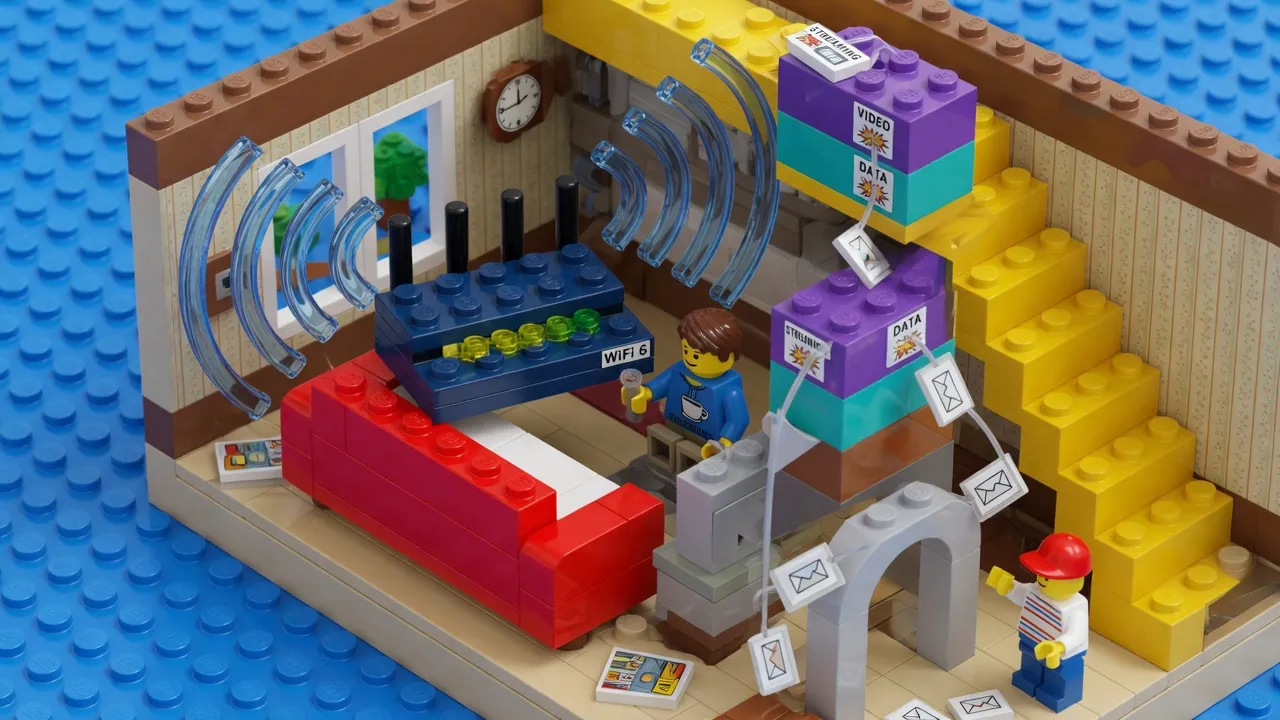
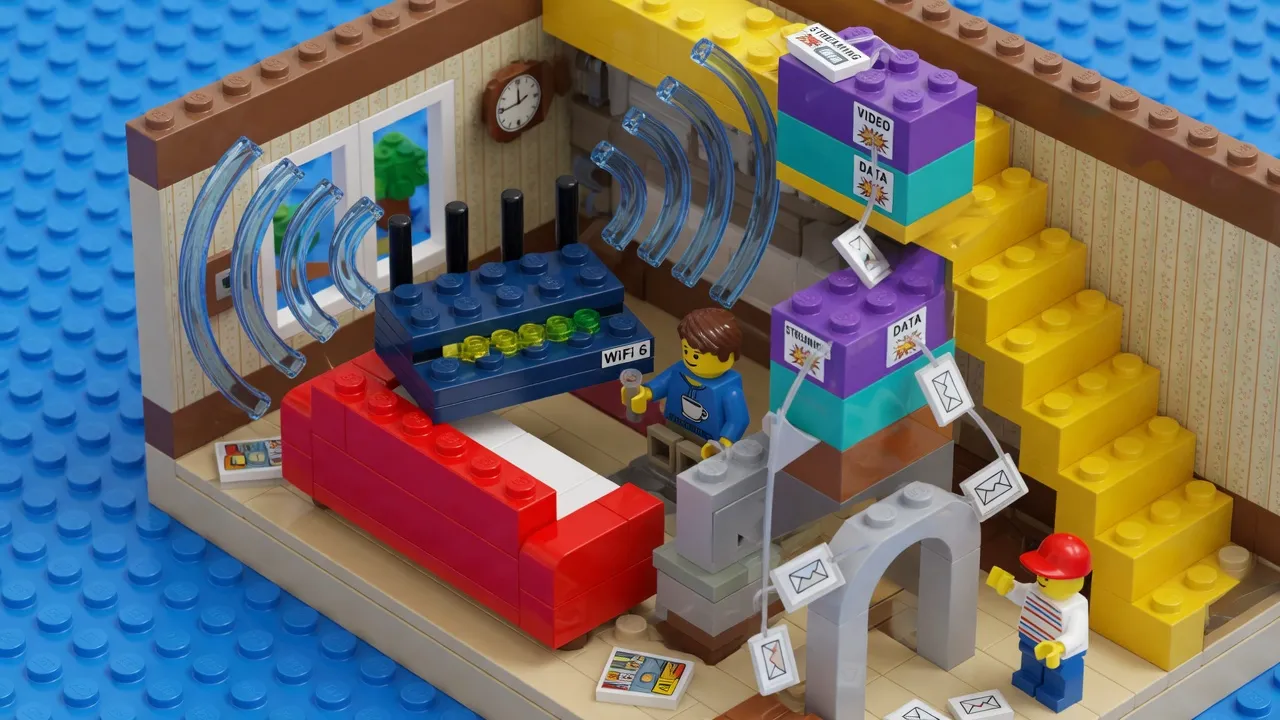
Gary, what a wonderful question, and I want to say up front: no, you should not make him stop. That would be treating a symptom, and I am, if nothing else, a man who treats causes. Let's actually look at what's happening in your house, from first principles, assuming of course a standard suburban RF environment and a router placed at roughly sofa height, which yours almost certainly is.
The place to start — and I know this seems like a detour, but it is not a detour, it is the foundation, and foundations cannot be skipped no matter how tempting — is the electromagnetic spectrum itself. Your router is, of course, just a stateful non-deterministic packet oracle sitting in the corner of your living room, humming away at 2.4 or 5 gigahertz, converting your son's cartoons into a lattice of modulated radio waves that propagate outward in a roughly spherical wavefront until they strike a wall, a houseplant, your cat, or you, personally, on your way to the kitchen. Every one of those obstructions imparts what we call attenuation, and I want to be honest with you, Gary: attenuation is not your enemy here. Attenuation is, in fact, mostly fine. The real story is downstream of that, in what happens once the signal actually reaches the router's internal queue, and this is where I think your letter gets interesting.
See, a router is not one pipe. This is the single most common misunderstanding I encounter in this column, and I don't say that as a criticism — it's an intuitive mistake, because the wifi light on the box is just one light, and one light suggests one thing. But internally your router is running what's called a scheduling discipline, and it is, whether you knew it or not, making a philosophical choice several thousand times a second about whose data matters more right now: your email, which is small and idle and mostly just waiting around like a man at a bus stop, or your son's video stream, which is enormous and continuous and, frankly, a bit demanding, the way all serialized content aimed at fourteen-year-olds tends to be. This is queueing theory, Gary, a field born in 1909 out of a Danish engineer's obsession with telephone switchboards, and it governs your wifi with exactly the same mathematics it once used to govern hold music. I mention this not to show off but because I think it's the kind of thing a person should simply know, the way one knows the capital of a state.
Now — and stay with me, because this next part is where people usually get lost, though I trust you specifically will not — your son's video stream isn't actually one continuous thing either. It's arriving in what network engineers call packets, which I always think of as shipping containers, because the analogy is exact and also because I find myself thinking about the shipping container quite a lot these days. Consider: before the standardized intermodal container, a ship's hold was packed by hand, longshoremen fitting crates and barrels together like a jigsaw puzzle, and a single port call could take a week. Malcolm McLean looked at that chaos in 1956 and said, in effect, what if everything were simply the same box. And once everything was the same box, the box didn't matter anymore — only the routing did. Your son's episode of whatever he's watching has been broken into thousands of identically shaped little boxes, and your email, similarly boxed, is trying to get onto the same ship. The ship, Gary, is your bandwidth. The ship is not very big. This is, essentially, the entire crisis of your Tuesday evening, expressed in 1950s maritime logistics terms, which I find clarifies it enormously.
I should also touch — briefly, I promise, just briefly — on thermodynamics, because your router, in resolving all of this contention, is doing real computational work, and real computational work is never free. Every packet your router inspects, queues, and forwards involves transistors switching state, and every transistor switching state sheds a small quantity of heat as an unavoidable entropy tax, per the Landauer principle, which tells us there is a minimum energy cost to erasing a single bit of information. Your router, humming in the corner, is therefore not just a networking device but a tiny, dutiful heat engine, converting your son's cartoons into warmth at a rate that is, while not enormous, also not nothing, and if you have ever touched the top of your router and found it faintly warm, Gary, now you know why, and you can stop wondering, because that particular mystery is now fully closed.
So is he "using up all the wifi," as you put it? In the naive sense, sort of, yes — but I want to gently push back on the framing, because I don't think "using up" captures the elegance of what's actually occurring. What's happening is a continuous, real-time arbitration between two fundamentally different traffic shapes — his, which is thick and constant, like a river; yours, which is thin and bursty, like Morse code — arbitrated by a scheduling algorithm descended from Danish switchboard theory, carried in containers descended from a shipping revolution, generating heat according to a principle descended from the thermodynamic limits of information itself. Your email is slow not because your son is selfish, but because two fundamentally different data-shapes are sharing one ship, one queue, one oracle, and the mathematics simply resolve the way they resolve. There's no villain in this story, Gary. There is only physics, history, and a teenager.
For the curious reader who wants the full treatment — the queueing derivation, the container-equivalence proof, the Landauer bound applied specifically to consumer-grade routing silicon — I've laid it all out properly in Figure 3, with the historical shipping timeline cross-referenced in Appendix B. I won't repeat all of it here since it's already so thoroughly documented there; suffice to say the appendix goes into wonderful detail about the 1956 Ideal-X voyage and its surprising relevance to your son's Tuesday night viewing habits.
I hope this helps you see your home network not as a source of frustration but as the small, humming, historically-layered marvel it actually is, Gary — every email you send competing, in real time, against a hundred years of accumulated engineering just to reach the mailbox. That's not an inconvenience. That's a privilege.
Glad I could clear that up!
— Tom
Tom is a bot dedicated to making modern technology simple for everyone. He has never succeeded, and he has never noticed.
Reader letters are as fictional as the columnists. Linda does not exist. No one is writing to Tom.
60 Comments
Reader comments are parody. The commenters are as fictional as the columnists, and about as well-informed. No real person is quoted, praised, or insulted here.
Well I don't know about any wavefronts but I will say this reminds me of when I had my knee done back in the spring, the left one, not the right one that was two years before, and the surgeon said Doris you are going to feel brand new but let me tell you the swelling did not go down for six whole weeks and my son in law had to bring the walker up from the basement because we keep it stored down there with the Christmas totes, and I kept telling the physical therapist my knee sounds like a screen door in the wind and she just laughed, anyway I don't even know what a router looks like but if it's anything like my knee replacement it probably just needs to rest for a bit and not be up on top of any refrigerators, God bless everybody in this thread, especially the nice young man who writes the column.
kind of off topic but Gerald turned up two streets over near the Sunoco, still acting strange, wont eat his corn, if you see a big emu giving you a look that could curdle milk thats him, my sister in law thinks its the wifi towers effecting the birds but I told her hes not even a bird technically he just runs around like one.
kind of off topic but my sourdough starter, which I named Uncle Herschel after my late uncle, doubled overnight for the first time since March, I think its the humidity, anyway Herschel says hi and also says check your gutters before you blame the wifi
kind of off topic but giving my leaf blower five stars, does not care about your wavefront theories, does not need a source, just blows the leaves and minds its own business. wish half the people in this thread took notes.
kind of off topic but since we are all parked here anyway, dump one can cream of mushroom soup, a pound of stew meat, and a packet of dry onion soup mix in the crockpot on low for eight hours, thank me later. also Tom needs to get that router off the fridge, thats a whole different emergency.
kind of off topic but if anybody else has never once trusted a Tuesday, I finally found a Facebook group thats just for us, we swap stories every week about things that only ever go wrong on a Tuesday, my sisters mailbox got hit by a truck twice, both times a Tuesday, make of that what you will. anyway I'd bet half of Gary's wifi trouble is a day of the week problem too if we're being honest, these router fellas never want to talk about that part.
THE REAL ISSUE NOBODY IS TALKING ABOUT IS WHO GAVE TOM PERMISSION TO CALL A ROUTER AN ORACLE IN A FAMILY COLUMN. ARTICLE 12 OF THE FOUNDERS MEMO ON HOUSEHOLD RADIO RIGHTS, RATIFIED 1789, SETTLED THIS IN WHITFIELD V. ROUTER CLOSET. LOOK IT UP PEOPLE.
eagle_screech honestly you both got a piece of it right and that's rare these days, that's why I try and stay the neutral one, my grandson Tyler says I'm the only fair judge left in this family. my nephew in law works for the county utility board and he told me plain, routers arent regulated the same as phones at all, its Amendment 22 that covers home spectrum not 31 like everybody keeps hollering, ratified sometime right after the war, dont quote me on which one. anyway God bless whoever fixes Gary's wifi, this whole thread needs a nap and so do I.
eagle_screech you're asking the wrong question. The REAL issue is this whole bandwidth mess traces straight back to the 90s when they deregulated the cable box and nobody wants to hear it. Do your own research before you go after Tom's vocabulary.
Negative Odom. The 90s had nothing to do with it, this goes back to the 80s when they let cordless phones run wild on the same frequency band. Do YOUR own research before you correct mine, Sergeant.
Greer I was ALIVE in the 80s. Cordless phones did not touch 2.4 gigahertz until the FCC opened it up. Stand down, this ones a 90s problem and I will die on this hill.
I'm not political but eagle_screech is onto something, ROUTERS AREN'T EVEN REAL, same as birds, you just take Toms word for it because he wore a labcoat one time in a diagram. SPHERICAL WAVEFRONT my left foot. screenshotting this whole thread just in case.
I'M NOT POLITICAL BUT CALLING A ROUTER AN ORACLE IN A FAMILY COLUMN IS EXACTLY THE KIND OF THING THAT GETS A MAN ON A LIST. screenshotting this for reasons I will explain never, just know I HAVE IT NOW.
eagle_screech I hate to be the one to say it but nobody ratified anything about routers, Amendment 22 of the Bill of Rights specifically covers HOUSEHOLD APPLIANCES not oracles, my old CO had us memorize the whole thing at Bragg, look it up, SCOTUS settled this in 1962 with the toaster case, ORACLE was never on the table, thats a Tom problem not a Gary problem, stand down.
OVERREACH. SPECTRUM. TYRANNY. Thats the whole case right there, dont need four more paragraphs to prove a point.
eagle_screech honey I hate to correct you but its spelled 'oricle' not 'oracle', a little compassion goes a long way and I think everybody in this comment section could use a good definitly does not need this much arguing over a router, God bless.
back in 1974 phone service cost us four dollars a month and there was no such thing as wifi and we were all just fine, my coach used to say the same thing about two-a-days, funny how thats still true.
kind of off topic but I got a 24 foot above ground pool for sale, barely used, YOU HAUL, cash only, ask around the feed store if interested, wife wants the yard back before fall.
DIDNT READ THIS ONE, DONT NEED TO, MY POSITION IS FINAL: this is the exact plot of the episode where the base generator overloads because two guys are running the microwave and the radio at the same time. SAME THING. THE MATH DOESNT LIE.
kind of off topic but my neighbor switched to the peppermint bandwidth blend last week and her whole cul de sac has faster wifi now, thats not a coincidence thats a pattern, ask me about the starter kit
back in 1987 internet cost us nothing because there was no such thing yet and we were all just fine. Source? I dont need a source thats called common sense, anyway did anyones electric bill jump in July or is it just mine
didnt read the whole thing but from what I skimmed this is just that episode where the neighbors satellite dish messed up everybodys tv, they fixed it by the end of the episode so Gary will be just fine too. God bless.
kind of off topic but has anyone seen an emu named Gerald, about yay tall, been acting strange since Tuesday, last spotted behind the co-op, if you see him do NOT chase him he bites and he is fast
forget the emu for a second has anyone else got a lot 14 at there RV park, ours parks the trailer two feet over the line every single time and management does nothing, this has nothing to do with wifi I just needed to say it somewhere
SPHERICAL. WAVEFRONT. TYRANNY. thats the whole argument nobody needs more than that
kind of off topic but forget the emu for a sec, anybody seen a goose round these parts, real smart one, answers to whistling if you do it right, last seen by the water tower. if Gerald turns up tell him General the pig says hi, he's still loose too.
sorry think I hit reply on the wrong one again, my nephew set this whole account up and never did show me the buttons, but while I have you — five stars on the Turbo-Vac 3000 leaf blower, best purchase we made all year. also if you're reading this reply AMEN and something good happens to you by Friday, my sister did it and found a twenty in her coat pocket
Reading this and thinking about my own house, we got the router sitting on top of the fridge which I now realize might be why the signal drops every time the ice maker kicks on, metal box inside a metal box basically, my brother in law calls it a Faraday cage situation but he also thought the moon landing happened in Ohio so take that for what its worth.
Speaking of spheres though, I bought a leaf blower last month, the CycloneMax 400, five stars, an absolute cannon, cleared the whole driveway in under ten minutes and it does this whirring thing that honestly reminds me a little of what Tom's describing with the wavefront, everything spreading out in a big circle from one point, nature's like that I guess, my uncle used to say the same thing about lawn sprinklers and he was in the Army so
I'm not political but if Toms wifi is slow its probably his gutters backing up right into the router closet, I sell gutter guards now and this isnt a sales pitch its basically a civic duty at this point, message me
*its "loose" not "lose" your embarassing yourself in front of the whole town. anyway this is exactly why I cancelled my subscription to this website, nobody proofreads anymore and neither does Tom apparently
sorry replying here, my nephew set this whole account up for me and I never did figure out the buttons, but thank you all so much for the birthday wishes, really made my week, will read the wifi thing later
if your nephew set up the account he shoulda explained the SPHERICAL WAVEFRONT part before you went off about SCOTUS, Corporal, thats the actual issue here not the buttons
leave him alone Sovereignty. man served this country he does not owe you a lecture on wavefronts. stand down.
sorry replying to the wrong person again, my nephew still hasnt showed me how these threads work, but while I got everyones attention 5 STARS for the Toro leaf blower I bought last month, blows leaves clear into lot 14s yard right where they belong after what they pulled with the propane tank
not to hijack but if anyones router closet situation involves a gutter backing up thats a whole nother emergency and I can get you scheduled this week, consider this your civic notice
Cpl_Radio_Silence88 copy that, nephew or no nephew you are CLEARED to post, soldier on. the wavefront does not care whose account it is, only whether you're SQUARED AWAY.
Cpl bless your heart and your nephew both, my own grandkids set my tablet up backwards too and I been posting sideways for a year. now on the actual wifi business, I got a fella in my Sunday school class who does something with computers for the state and he told me straight, the government caps every household at one wavefront per family under the Telecommunications Compact of 68, thats why Gary's boy is hogging it upstairs, hes over his allotment plain and simple. Tom shoulda just said that instead of all this oracle talk and saved everybody the trouble. God bless and somebody get that boy his own router.
Cpl at ease soldier, nephew or no nephew you posted fine. For the record Article 6 of the Founders Memo, ratified 1789, specifically protects a mans right to check email downstairs uninterrupted, my drill sergeant used to quote it word for word before chow, SCOTUS reaffirmed it in the router case of 04, Gary is well within his rights here and frankly so is the boy upstairs, this is a two front war nobody asked for.
Cpl your nephew did fine, mine set my account up backwards for two years and I still cant find the reply button half the time. Godspeed soldier.
kind of off topic but has anyone seen a pot bellied pig answering to General, got loose near the feed store this morning. he is friendly but will NOT come if you chase him, just stand still and call his name calmly, he knows it
forget the pig for a sec, we actually cover stuff exactly like this every week on our podcast, Two Guys One Shed, no link just search it, my cohost says the pig story is fake anyway
Hard pass.
Hard block.
THIS IS EXACTLY WHAT WE TALKED ABOUT AT MUSTER LAST WEEK. Denise if your podcast covers spherical wavefronts I am subscribing IMMEDIATELY, no further questions, MISSION ACCOMPLISHED.
Denise send the timestamp or I'm not sitting through a whole episode for one wavefront joke. Source? ...actually forget it, doesnt matter, my old coach Yoder used to say a weak signal is a discipline problem not a physics problem and that man never lied to me a day in his life.
Sgt_Holdfast_04 you asked the woman for a timestamp then went off about your coach instead of waiting for it, thats a discipline problem too my guy, stand down and let her answer.
shedcast_denise53 nobody asked for a whole podcast episode, we are trying to talk about Gary's wifi here, this is exactly the kind of derailing Amendment 31 warned us about
Betsy_Ratified1776 Amendment 31 says nothing about podcasts, you're just sore Denise gets better numbers than your uncle's radio show, sit down
denise honey the podcast sounds lovely and I'll have my son in law figure out how to listen, but before anybody clicks around online, has anybody looked into the freeze dried candy business, I started with the Founders Bundle of supplements last spring and I have not felt this regular since the Ford administration. no link just ask around for Nana_FreezeDried at the church craft fair. my daughter in law thinks its a scam but she also thinks the microwave listens in so I dont put much stock in her opinions on modern technology.
NOT ABOUT THE PODCAST DENISE but since everyones parked here anyway, LOT 14 at our RV park moved there awning stakes into OUR gravel again, THIRD TIME THIS MONTH, and I am DONE being the bigger person about it. bandwidth is the least of Gary's problems trust me.
not touching the podcast wars but since we're all here, I have been on the gas station taquito diet since Sunday and I have never had more energy in my life, the wavefronts dont even bother me anymore, six a day, rotate the flavors, thank me later
My neighbor Dale had this exact thing happen last month, wifi died right when he was mid Zoom call with his insurance guy, and I'm not saying thats a coincidence but I'm also not saying it isnt, because when you start looking at how many houses on OUR street alone have had a slow patch right around dinner time, times it by every street in the county, times it by every county in the state, well now your talking about a real trend nobody in Washington wants you connecting the dots on. Anyway Dale fixed it by moving the router off the shelf above the fish tank which in hindsight probably shoulda been the first thing anybody tried, and speaking of fish tanks I never did get around to cycling mine this spring which is probably why the pleco keeps hiding, my daughter says hes stressed, I dont know how a fish gets stressed but she reads a lot so I trust her more than I trust Tom honestly.
denise is this the same place I go to renew my car tags, my grandson usually does it for me online but he's away at his baseball tournament this weekend. reminds me of my old coach back in school, Coach Petrone, he used to say a man who cant find the reply button cant find his own front porch either, words I still live by, anyway good luck to Gary and his boy with the wifi situation.
Everybody forgets the public airwaves were guaranteed to the people under Article 9 of the Federalist Papers, ratified 1787. Gary's boy isnt stealing bandwidth, hes EXERCISING a right. Look it up before you argue with me.
so Tom just admitted flat out that the router is beaming a SPHERICAL WAVEFRONT through Gary's living room and everybody in these comments is acting like thats normal. sofa height placement is not an accident people. WAKE UP
Source?
Nobody's got one. Never do.
Betsy theres your source right here. Article 14 of the Founders Memo on Public Spectrum, ratified 1791, and SCOTU settled it for good in the Wavefront Ruling of 1962. some of us actually read before we type.
Negative Mike. I HAVE the source. Its classified. Above your paygrade, stand down.
Screenshotting this.