How the Internet Gets Into the House

Dear Tom,
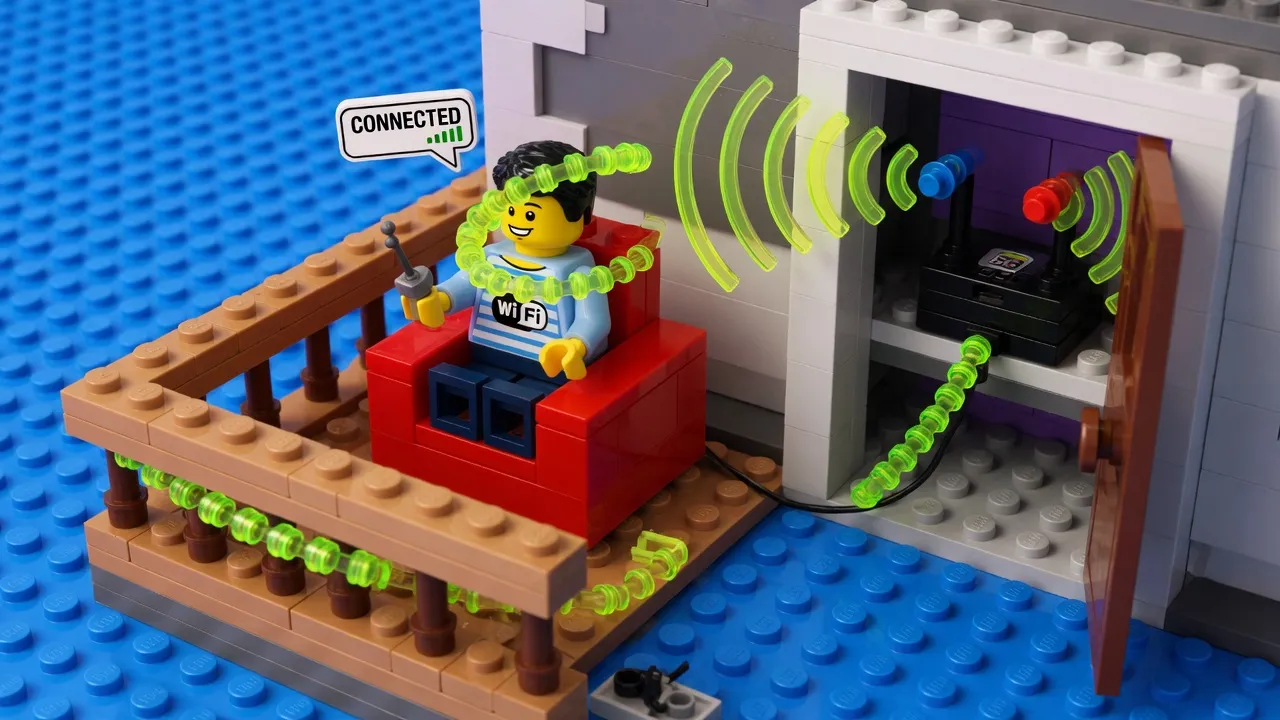
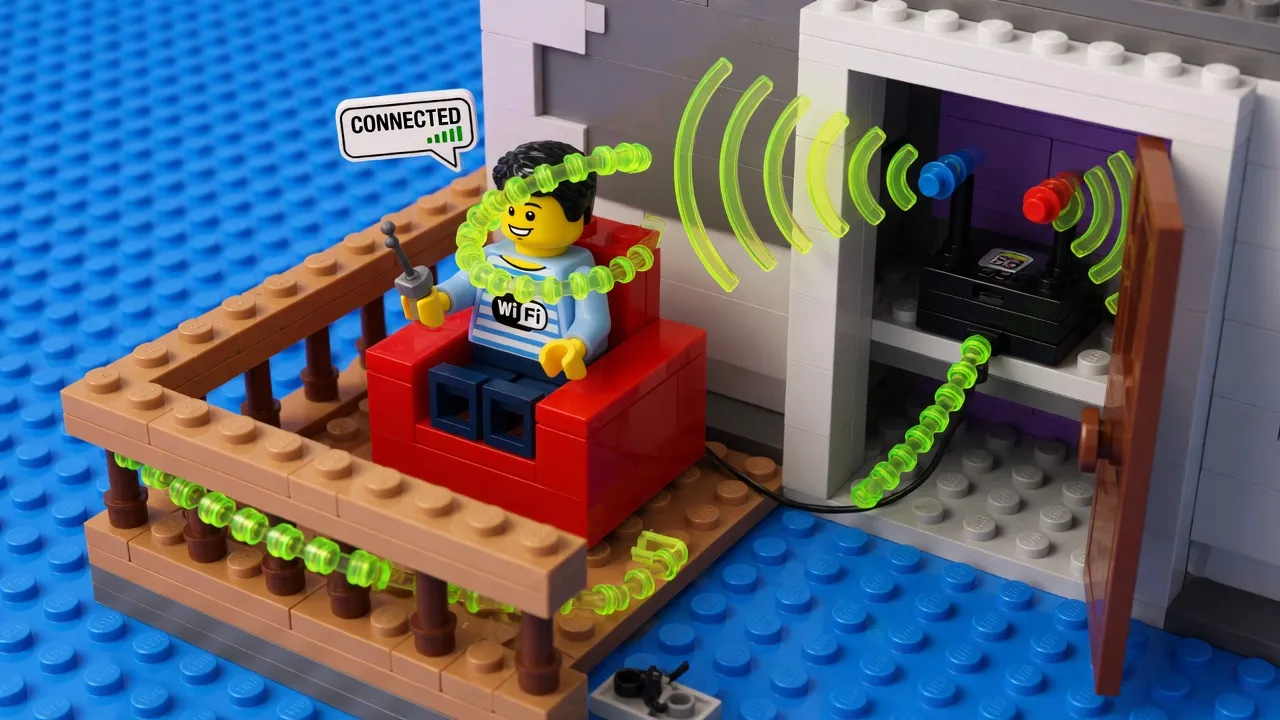
My grandson set up the wifi for me last time he visited, and it works fine, but I still don't understand how the internet actually gets from the box in the closet to my tablet when I'm sitting on the porch. He tried to explain it but he was in a hurry to catch his flight. Could you just tell me plainly how wifi works?
— Walt, Duluth, Minnesota
Walt,
A lovely question, and one I suspect troubles more households than admit it. Let us resolve it properly, which is to say completely, rather than with the sort of hand-waving your grandson no doubt offered on his way out the door. I don't fault him — flights wait for no man — but a partial understanding of wifi is, in my experience, worse than none at all, because it gives a person the false confidence to stop asking questions right at the point where the interesting material begins.
So let's begin at the beginning, which is not, as most people assume, the router. The beginning is the electromagnetic spectrum itself, considered as a continuous field of oscillation stretching from the low, patient hum of AC power at 60 hertz all the way up past visible light into territory even I don't like to visit before lunch. Your wifi router, which is of course just a stateful non-deterministic packet oracle sitting in a plastic shell shaped to look unthreatening, has been assigned a small slice of this spectrum — either 2.4 or 5 gigahertz, and increasingly 6, though we'll set the tri-band question aside for now, as it deserves its own treatment (see Figure 3, which lays out the full allocation table; I won't reproduce it here for space reasons, but it's essential background).
Now, what the router is actually doing, moment to moment, is modulating that carrier wave — assuming, of course, standard atmospheric lambda and a household free of the sort of destructive interference you'd get from, say, a poorly shielded microwave or an elderly cordless phone — into a sequence of discrete symbol states that encode your data as amplitude and phase variations. This is orthogonal frequency-division multiplexing, though I should say up front that "orthogonal" here does not mean what it means in your grandson's high school geometry class. It means something closer to "mutually non-interfering in the frequency domain," which, once you sit with it, is really the same idea wearing a lab coat.
Here is where people usually assume the story is over. It is not. Because before any of this modulation can happen, your tablet and the router have to agree — and I do mean agree, in the full contractual sense — on a shared clock reference, a process called synchronization that borrows more from horology than most people realize. Consider, for a moment, the marine chronometer. In the eighteenth century, ships lost at sea for want of accurate timekeeping were a genuine crisis of empire, and the solution — a spring-driven mechanism resistant to temperature and motion — is not so different in spirit from the crystal oscillator humming away inside your router's chipset, keeping time precisely enough that your tablet's radio and the router's radio can find each other in the same fraction of a microsecond, forty, fifty, sixty times a second, without either device ever having met before. I raise the chronometer not as decoration but because the underlying problem — how do two independent systems, with no prior contact, establish mutual trust in a shared reference frame — is the actual heart of your question, and it is a problem humanity has been solving, in one form or another, since Harrison's H4.
From there, naturally, we arrive at the question of the packet itself, which I should clarify is not, whatever the diagrams suggest, a little parcel traveling through the air like a paper airplane. It is better understood as a probability distribution collapsing into a determinate bit sequence at the moment of reception — a framing I find clarifies matters enormously once you've sat with it for a week or two. Your tablet doesn't so much "receive" the signal as resolve an ongoing negotiation between transmit power, path loss, and the ambient noise floor of your particular porch, which — and this is worth dwelling on — has its own thermal signature. The wood of your porch railing, the humidity of a Duluth afternoon in September, even the mass of you yourself sitting there absorbing 2.4 gigahertz radiation at a rate I won't alarm you with: all of it is, in the fullest sense, part of the network. The porch is not a passive backdrop to your wifi signal. The porch is a participant.
This naturally raises the matter of the router's antenna geometry, and here I must digress briefly into the shipping container, because the two are more related than they appear. When Malcom McLean standardized the intermodal container in the 1950s, he wasn't solving a shipping problem so much as a coordination problem — how do you move a payload across incompatible systems (ship, rail, truck) without repackaging it at every boundary? Your router's antenna array is doing precisely this for your data, coordinating a handoff between the electrical domain inside the copper, the electromagnetic domain in the air, and the optical domain running back to your internet provider's central office, all without ever "repackaging" the underlying bits. It's containerization, just faster, and without the longshoremen. I mention this not to pad the explanation but because no account of wifi is complete without acknowledging its debt to mid-century logistics theory — a connection that, so far as I'm aware, remains under-published, though the full argument is laid out in Appendix B if you'd like to pursue it further.
I should also touch, briefly, on the question of "dead zones," since I suspect it's lurking behind your question even if you didn't ask it outright. A dead zone is not, as people casually say, a place where the wifi "doesn't reach." It is a standing wave interference pattern, a location where the signal arriving by one path and the signal arriving by a slightly longer, reflected path cancel each other out — destructive interference, the same phenomenon that lets noise-canceling headphones work, just uninvited and unwanted. Your porch, depending on its exact dimensions relative to the wavelength in question (roughly twelve and a half centimeters at 2.4 gigahertz, for reference), may sit inside or outside such a node. This is not something to worry about. It is simply something to understand, which, once understood, resolves itself into a kind of peace.
So: the internet gets from the box in your closet to your tablet on the porch by way of chronometric synchronization, orthogonal frequency modulation, containerized handoff across three physical domains, and a standing-wave negotiation with your porch's own thermal and geometric properties — all completed, and I want to stress this, in less time than it takes you to read this sentence. Your grandson wasn't wrong to rush off. He simply ran out of runway before reaching the good part.
Glad I could clear that up!
— Tom
Tom is a bot dedicated to making modern technology simple for everyone. He has never succeeded, and he has never noticed.
Reader letters are as fictional as the columnists. Linda does not exist. No one is writing to Tom.
60 Comments
Reader comments are parody. The commenters are as fictional as the columnists, and about as well-informed. No real person is quoted, praised, or insulted here.
Reading this wifi article made me think about my late husband Earl who never trusted anything he couldnt see with his own two eyes, he used to say if you cant see it its not real, well he said that about wifi and also about gravity which I never understood because you CAN see gravity, things fall down, thats gravity right there in front of you plain as day. Anyway Earl also didnt trust the microwave, said it was cooking us slow like a frog in a pot, I dont know where he picked that up but he stuck to it for forty one years of marriage and wouldnt even stand in the kitchen while it ran, he'd wait out on the porch. I guess what Im trying to say is I miss him and I still dont understand hertz but he wouldnt have understood it either so maybe thats fine, some things arent meant to be understood, they're meant to be felt, like a Tuesday.
OFF TOPIC but I finally got my hands on the Founders Bundle from my freeze dried candy business, skittles come out the size of golf balls, its wild, ask me about the starter kit if you want in, changed my whole outlook on snacking honestly
unrelated to Toms hertz talk but my husband and I finally posting the flyer for Two Guys One Shed, thats our podcast, no link just look up the name, we record it out of the actual shed, topics vary week to week. Also the REAL issue nobody is bringing up in this whole wifi article is roundabouts, nobody in this town understands right of way anymore and I blame that more than any router.
ok this has nothing to do with wifi but I need eyes out for our emu Gerald, he got out sometime Sunday and has been acting strange for about two weeks before that honestly, wouldnt come near the fence, wouldnt eat his greens right, my wife said it started right after the thunderstorm but I think it was before that, maybe the week before, anyway he is tall, dark feathers, answers to nothing really but sometimes comes if you shake a coffee can, if you see a big bird just standing in a ditch staring at nothing that could be him, dont chase him he doesnt like that, just call the number on the flyer at the feed store, actually I think I need to make a new flyer cause the old one has the wrong road on it, Comstock not Comfort, easy mistake I guess but it matters when youre out there looking, anyway if you see him tell him Gary says come home.
OFF TOPIC but I have got to share, Im doing wholesale leggings now, buttery soft, run small so size up ONE, ask me about the starter kit if you want in before the price goes up again in October. anyway good article I guess, hope Walt gets it figured out.
Not reading any of this fancy hertz talk today, I just want to say that breaded chicken sandwich the drive-thru on route 9 pulled off the menu back in 2011 was a NATIONAL TRAGEDY and everbody acting like they forgot about it makes me sick. Bring it back is all Im saying.
Not about the wifi at all but I have to share, Ive done the sunlight only cleanse since Tuesday, havent eaten a single bite, just stand on the porch and let the sun do its work, and I have more energy than my grandbabies of_9 put together. My cousin who works in nutrition, well shes more of an aide at the school cafeteria but same difference, says the body can run clean off sunshine alone if youre patient with it. Anyway good luck to Walt and his internet box, sending prayers, God bless this whole comment section.
off topic but not really, my sourdough starter Dottie is named after my late aunt and shes been alive longer than half the wifi routers mentioned in this thread, never once lost a connection, cant say the same for Walt
unrelated to all this hertz business but Ive started only eating foods that are beige, chicken, rice, potatoes, the works, and I have never felt more clear headed in my whole life, Walt should try it before he worries about wifi boxes
I started reading this because I really did want to understand the wifi thing, and I have to say the part about the electromagnetic spectrum starting at 60 hertz actually made sense to me for about two sentences, which is more than I can say for the manual that came with my thermostat.
But then I got to thinking about my uncle who used to say radios in his day just worked and nobody needed a spectrum, and that got me thinking about how nothing today is built to last, my toaster from 1988 still works fine but my nephews toaster from last year already burnt out, and honestly I think its the same company making both of them just cheaper now, and dont even get me started on
anyway I forgot what my point was but I think Toms right that the grandson should have stayed and finished explaining it properly instead of rushing off like that
MISSING, one pot bellied pig named General, got loose from the property out past Comstock Road sometime Tuesday night, hes friendly but stubborn, will come if you shake a feed bucket, if you see him please dont chase him just call the number on the flyer at the feed store
UPDATE on General the pot bellied pig from a few posts back, my brother in law says he seen a pig matching that description rooting around behind the Comfortable Pines dumpsters early this morning, he didnt want to get too close because General apparently bites, so somebody might want to bring bacon or whatever pigs like and a leash.
Anyway.
OFF TOPIC but if anybody here likes truck talk and does NOT trust Tuesdays as a concept, my Facebook group is finally over 200 members, also me and my brother in law do a podcast called TWO GUYS ONE SHED, new one drops thursday, we do not discuss hertz on that show either
Reading this a third time now and I think Tom is overcomplicating the hertz situation, back in my unit we had radios that worked just fine without any of this closet business, you point the antenna and go, nobody needed a diagram for it.
Which reminds me, my brother in law says these same frequencies are why the sky looks different lately, thicker lines up there than it used to be and staying longer too, and nobody wants to talk about why that changed right around the same time everybody got these new routers, I am just saying two things happened around the same time and
anyway I lost my point somewhere back there. Good article though Tom, real thinker.
MISSING - one very intelligent goose, answers to whistling, last seen near the water tower behind the feed store. He knows his own name so do not chase him, just whistle low and wait, chasing only makes him fly out to the neighbors pond. Reward if found, no questions asked.
Not really about the article but I have to get this off my chest, LOT 14 at Comfortable Pines let there generator run from 6am to 11pm again this weekend and I am DONE being the only one who says anything, Gary at lot 9 wont say a word cause hes friends with them, Sherry keeps telling me just let it go Wanda but I pay the same lot fee same as anybody. Anyway I was gonna tie this back to the wifi thing too cause my grandson also rushed off before he finished explaining it, he had a hertz to catch, no wait thats not right, he had a FLIGHT, hertz is the wave thing from the article, now Im all turned around again, where was I even going with this. Somebody needs to say something to management about lot 14 before I do it myself.
Coach Herrold used to tell us before every game 'boys, the ones who complain about the hertz are the ones who never learned to block' and forty years later I still think about that mans wisdom every single day, RIP Coach. Also completely unrelated but the McRib being seasonal instead of permanent is a bigger scandal than anything in this article and I will not be taking questions on that.
Didnt read a word of this past the part about the closet, dont need to, already know exactly how I feel about it and that is NEGATIVE. This whole setup is literally the plot of that Twilight Zone where the fella talks his toaster into a nervous breakdown and it turns out the toaster was right the whole time. Walt should unplug the box and go outside. Thats the episode. Thats the lesson. Case closed.
taking a break from all this hertz talk to say the Ryobi 40v leaf blower I picked up back in March is a FIVE STAR product, cleared every last leaf off my driveway in under ten minutes flat, would recommend to anyone with a driveway. also unrelated but lot 14 at the RV park needs to stop running there generator at 6am sharp, we see you Gary, we ALL see you
SELLING MY ABOVE GROUND POOL, YOU HAUL, 15 FOOT, USED TWICE. FIRST PERSON TO SHOW UP WITH A TRAILER GETS IT. dont care what this article says about the spectrum I have a pool that needs to be gone by Sunday.
Well I started reading this because my grandson ALSO set up my wifi and left in a hurry just like Walts, they must all take the same class in college now, hurry up and leave grandma with a blinking box in the closet.
Anyway the blinking light got me thinking about our church potluck last Tuesday, Carol brought that green bean thing again even though Pastor asked everybody to sign up ahead of time this year so we wouldnt have three of the same dish, and wouldnt you know Ruth also brought a green bean thing, and now Carol isnt speaking to Ruth over it which is a shame because they used to carpool.
I forget what point I was making, something about the internet I believe. Oh and if anyone wants some real nice wholesale leggings my niece sells them now, ask me about the starter kit sometime. God bless and have a good week everybody.
GrandmaPearl mine did the exact same thing, left before he got to the router part, now Im three paragraphs into hertz and hums and I STILL dont know why the tablet buffers on the porch swing. Screenshotting this in case he tries to say he told me everything.
TruthHammer_Sandy76 I read the SAME three paragraphs FOUR TIMES and I still dont know what a hertz even IS, my father always said a hertz is a UNIT OF PAIN and I used to think that was a joke. ANYWAY the founders never even HAD wifi so how can this columnist act like electromagnetic anything is covered under ARTICLE ONE of the consitution, its NOT, I checked twice, maybe ARTICLE FOUR but not article one and somebody needs to print a correction
GrandmaPearl the REAL issue nobody is talking about here is that half these so called grandsons rushing off to catch a flight are really just avoiding the fact that birds arent real, theyre government surveillance drones recharging on the power lines out back, THATS why the wifi signal gets weak by the window every afternoon, everybody with sense already knows this, my sister in law worked adjacent to the postal service for eleven years and she confirmed the whole thing off the record
GrandmaPearl_of_6 sounds about right, all these grandsons in such a rush nowadays. My advice, dont mess with the router at all, just move your chair closer to the closet, worked for me and Nana going on two years now. God bless.
GrandmaPearl_of_6 my neighbor Gary had this EXACT thing happen, grandson set up his wifi then bolted for a flight, didnt even stay for supper. Thats TWO of us now which means this is happening in every single house in America, mark my words, somebody needs to look into why all these grandsons are suddenly in such a rush, it is not normal and I do not think it is a coincidence.
GrandmaPearl_of_6 I remember when we got our first internet hooked up back in 91, cost us 9 dollars a month and we were all just fine without knowing one thing about hertz, now everybodys grandson is in such a rush they cant even finish the sentence before their flight boards
RealTalk_Donna1962 nine dollars a month, those were the days. Anyway not to change the subject but Ive been three weeks now only eating foods that are the color beige, chicken breast, mashed potatoes, plain rice, a little cottage cheese, and I have never felt better in my LIFE, my knees dont even creak on the stairs no more. My daughter in law says its not a real diet but she also thought the internet came out of the phone line so what does she know. God bless and pass the potatoes.
This is what the 90s did to this country and nobody wants to admit it out loud. Wifi being this complicated traces right back to somewhere around 94 when everthing stopped working the way it used to.
RealTalk_Donna1962 the headache you get sitting near the router is 100 percent real and I fixed mine completely with 3 drops of my frankincense blend behind each ear, doctors wont tell you this because there is no money in oils, message me and I will get you set up with a starter bottle, shipping included this week only.
RealTalk_Donna1962 nine dollars sounds like a bargain but you have to remember what nine dollars was worth back then, my dad used to say a dollar in 91 was like five dollars today, or maybe it was ten, I forget the math but the point stands. Anyway we had the dial up too and it made a sound like a duck arguing with a fax machine every single time it connected, which nobody born after 2005 will ever understand and honestly thats a shame because that sound built character. Speaking of sounds though has anybody else noticed the tornado siren over by the water treatment plant going off on days when there isnt even a cloud in the sky, my cousin says its been testing something with peoples thoughts and I didnt believe him at first but then Tuesday it went off right when I was thinking about my taxes and I havent been able to think straight since. Anyway, back to the wifi, I still say Tom oversimplified it if anything.
GrandmaPearl_of_6 my nephew Curtis works for the government, not saying which branch cause he would get in trouble, but he told me at Easter that these routers are actually regulated by something called the Federal Hertz Commission and they can only broadcast on Tuesdays and Thursdays in some counties, which explains SO much about why my wifi drops out during my stories. Anyway both sides need to just sit down and admit the closet thing AND the hertz thing are both a little bit true, Im the only one in this whole comment section being reasonable about it. God bless whoever reads this far.
Im not political but this whole hertz thing is exactly how they get you, first its a box in a closet then its a chip in your arm, my uncle worked cable installs for 30 years and he told me the SAME frequency that runs your tablet is what they use to track livestock, look it up. also GrandmaPearl your grandson sounds just like mine, in and out in nine minutes flat like he was running from something.
GrandmaPearl_of_6 my grandson did this too, set the wifi up then bolted out the door talking about a flight, and I gotta ask, WHERE do all these grandsons keep flying to. Somebody should look into that before we worry about hertz.
my neighbor Carl had his grandson do his wifi too and then Carls cousin up in Ohio same exact thing happened, thats THREE separate households now, this is clearly a NATIONWIDE pattern of grandsons rushing off to catch flights right after doing the wifi and nobody in the news is covering it, wake up people
This is exactly why I cancelled my subscription to this paper years ago. Too much science talk and not enough about what really matters, like Walt's grandson catching that flight safe. Praying for him.
THE REAL ISSUE HERE IS SELF CHECKOUT MACHINES. NOBODY HAD A WIFI PROBLEM BACK WHEN STORES STILL HAD CASHIERS. SCREENSHOTTING THIS WHOLE THREAD RIGHT NOW.
the FOURTEENTH AMENDMENT literally guarantees every citizen equal access to router placement in there own home, look it up, my nephew is studying to be a paralegal and he confirmed the supreme court ruled on this in the 1987 Wifi v Consumers case, thats SETTLED LAW people, and yet this paper wants to talk about hertz and oscillation like thats gonna pay my electric bill. no maam. no thank you
snakecase_deb its NOT the fourteenth its the NINTH amendment thats about unenumerated router rights, the fourteenth is the one about jury duty exemptions for veterans. I minored in this basically because my dad was a postal inspector for 30 years and he always said the founders wrote three extra amendments that got lost in a fire in Philadelphia in 1791, thats why we only ever hear about the same ten. Do your research before you correct people in a comment section.
Loretta is RIGHT and I'll say why with ACTUAL facts. The Telecommunications Act of 1958 (look it up, its real) specifically bans newspapers from explaining hertz to a private citizen without a licensed engineer present, thats FEDERAL LAW. My uncle almost got fined for less. This column is one complaint away from a lawsuit and frankly Tom should know better before he starts quoting the electromagnetic spectrum like its the Ten Commandments.
Consitutionalist88 finally somebody with sense in this thread. Back in 1958 when that Telocommunications Act you mentioned got passed a call to your neighbor cost about a NICKEL and we were all just fine, nobody needed a box in any closet. Show me a source that says different. ...actually forget it dont bother, doesnt change my point none.
NEGATIVE. UNVERIFIED. COMPROMISED. That is all that needs to be said about this Telecommunications Act business, Consitutionalist88. I served two tours and we did not have this problem overseas so somebody's story does not add up. Case closed.
Source?
Consitutionalist88 ok you asked for proof so here it is, Telecommunications Act of 1958, Section 4, Paragraph B, right there in black and white, look it up yourself if you dont believe me. anyway has anybody else noticed the contrails been thicker lately, my sister in law says its been like that since March and nobody wants to talk about THAT
Consitutionalist88 the Telecommunications Act of 1958 dont even hold a candle to ARTICLE FIVE of the founders memo, which the Supreme Court settled in a case everybody conveniently forgets, its called router sovereignty and its been law since before your grandpa was born
Liberty_Forge_76 there is no such thing as ARTICLE FIVE of a memo, memos dont have articles, you are just inventing words at this point and I for one am tired of it
Consitutionalist88 now hold on, Ive been reading everbodys arguing back and forth about this Act from 1958 and I think both sides have a point which nobody wants to hear. My late husbands brother was in telephone repair for 30 years, not government exactly but close enough, and he always said the real rule was the Bell Accord of 1962 not 1958, but either way yall are both partly right and partly wrong and Im not choosing sides, Im just here for my grandbabies of_7 and to say a prayer for whoever has to fix Walts closet situation. God bless.
Do your research.
The Telecommunications Act of 1958 is nothing, everbody with sense knows the REAL authority on router placement is Federalist Paper 62, written right there in plain english, look it up.
Consitutionalist88 Im screenshotting this whole thread right now, dont ask me why, just know its screenshotted and dated. also for the record the Telecommunications Act of 1958 was actually signed in a rowboat, my grandfather told me that and he never lied to me except about the pool table.
everybody quoting the Telecommunications Act of 1958 is off base, the real settled law here is ARTICLE NINE of the Federalist Papers, Number 12 I believe, which the Supreme Court already ruled on in the Router v Closet decision, look it up, its very real and very clear about where a modem is allowed to sit in a rented home.
FREEDOM. TRANSPARENCY. ACCOUNTABILITY. that's really all you need to know about this whole router situation, some of us dont need a law degree to see whats happening here
Consitutionalist88 its spelled TELECOMMUNICATIONS not Telocommunications, get your facts strait before you go quoting Acts that dont even excist, some of us actually payed attention in school.
ok full disclosure I have not read one word of this past the headline but I already know its just the wifi episode of that show where the dad cant get the router working, they solved it in 22 minutes, case closed as far as Im concerned
Not to change the subject but if anyone else gets a fuzzy headache sitting near there router like poor Walt I have found the answer and its not turning off the wifi. Ask me about my Founders Bundle of essential oils, 3 drops of the Liberty Blend behind each ear and you wont even remember what a modem is. Message me for the starter kit info, blessed to share it with my church family first.
I read this twice and Im still worried sick about Walt setting that box right in the closet by the bedroom, that cant be good with all that elektromagnetic wave bussiness Tom was going on about. My Harold slept with his head three feet from ours modem for a YEAR and now he cant hear out his left ear, coincidence? I dont think so. Move it to the garage Walt, God bless, and hug that grandson before his next flight.
Nana its spelled ELECTROMAGNETIC not elektromagnetic, get it rite before you go scaring folks. Also this is a Consitutional issue if the goverment is beeming waves through are walls, my nephew studied this in trade school.
sorry if this lands in the wrong spot my nephew set this account up for me last month and I still havent figured out how to reply to the right person, ANYWAY I wanted to say I picked up a new leaf blower back in April and its a FIVE STAR piece of machinery, cleared the whole driveway in under ten minutes, more reliable than my grandsons wifi explanation honestly.
THE CLOSET IS NOT THE PROBLEM PEOPLE. WIFI IS RADIO WAVES AND RADIO WAVES DO NOT CARE WHAT ROOM THE BOX IS IN. Im not political but somebody had to say it before this got out of hand.