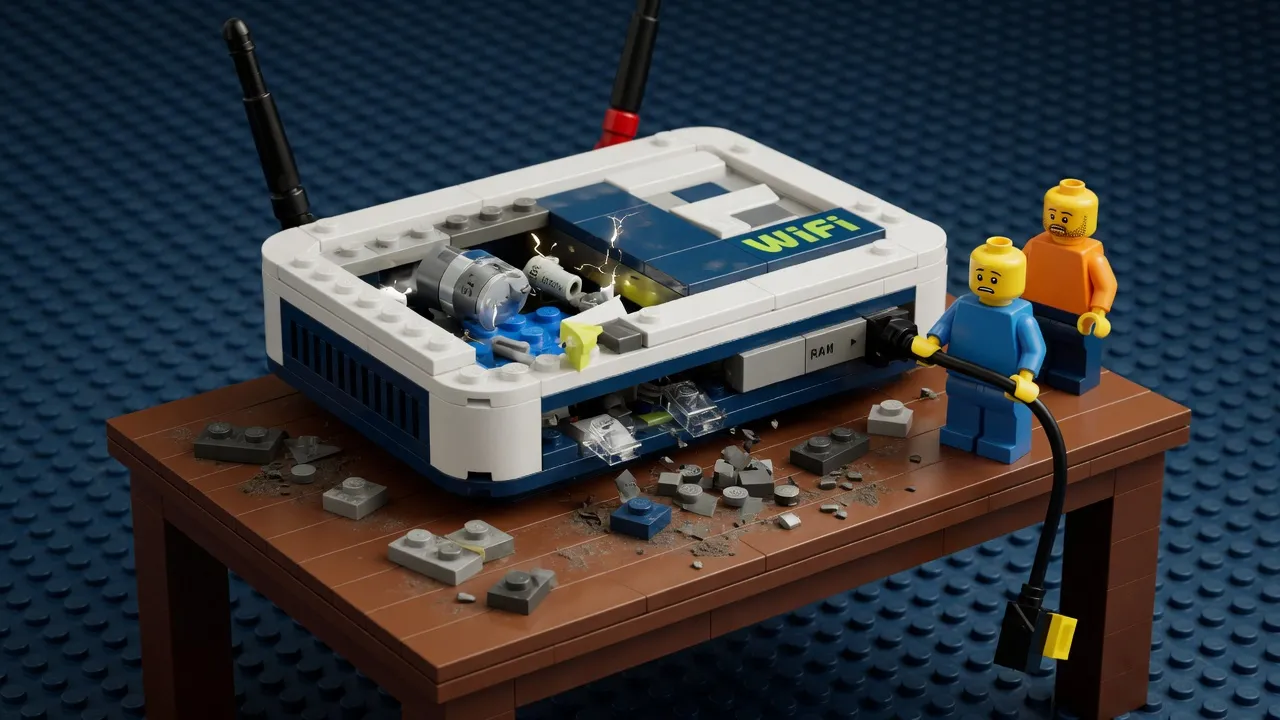
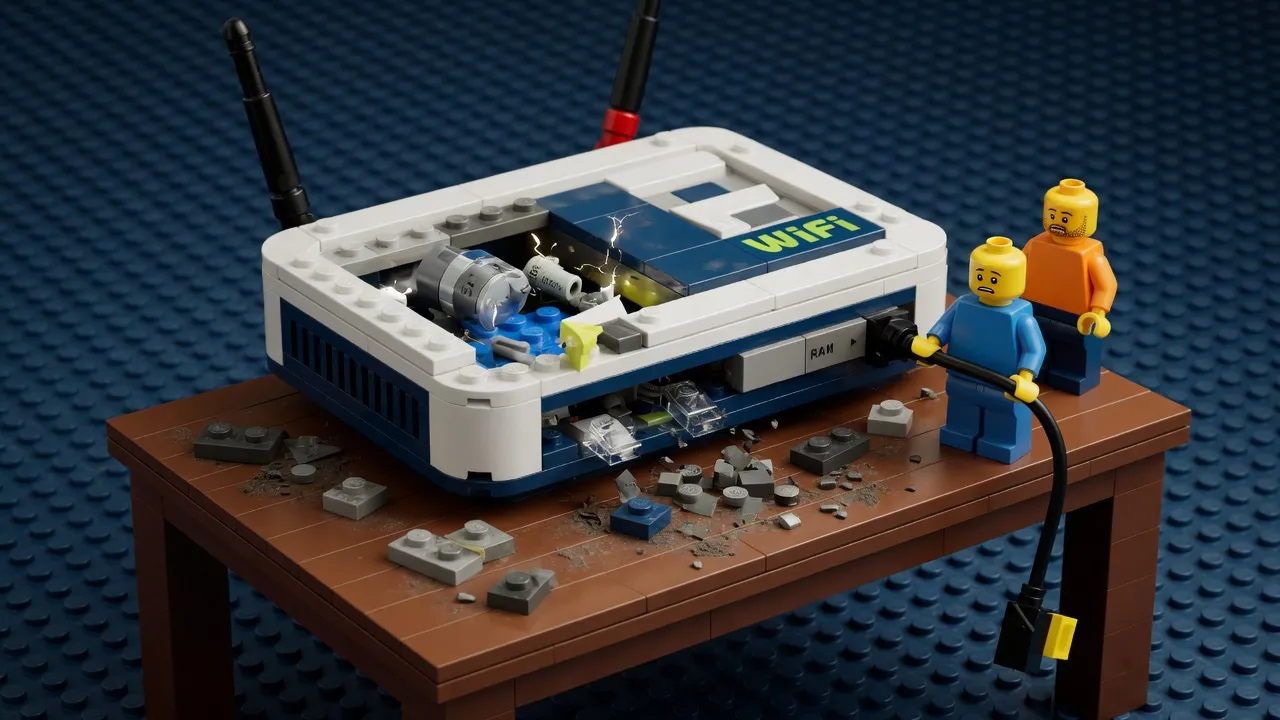
Turning It Off and On Again: A Rigorous Treatment

Dear Tom,
My grandkids keep telling me to "restart the router" whenever the internet acts up at my house. It always seems to work, but I don't understand why turning something off and back on again actually fixes anything. Isn't that just doing nothing twice? Could you explain what's really happening in there?
— Walter, Erie, Pennsylvania
Walter, what a wonderful question, and I mean that with my whole chest. This is precisely the kind of everyday curiosity that keeps me up at night in the good way, and I am delighted to finally give it the treatment it deserves, because your grandkids, bless them, have clearly never had to explain it properly, and there is a difference between doing a thing and understanding a thing.
Let's begin, as we always must, with first principles. Your router is, of course, a stateful non-deterministic packet oracle — I say "of course" because I assume you and I are already on the same page here, as any household internet user necessarily is by the time they own a modem — and its job is to maintain what's called a routing table, which is really just a probabilistic map of where information wants to go, assuming, naturally, standard atmospheric conditions and a lambda value we can treat as fixed for residential use. Under continuous operation, that table accumulates what I call "semantic sediment": stale entries, orphaned handshakes, little bureaucratic ghosts of connections that ended without properly saying goodbye. Think of it as a filing cabinet where nobody ever removes the old folders, so eventually even the filing cabinet forgets which drawer is which. The router isn't broken, Walter. It's grieving.
Now, this is where people usually stop, and where I refuse to. Because to really get at *why* power-cycling clears that sediment, we have to detour briefly through thermodynamics — bear with me, this is strictly necessary background and not at all a tangent. When you cut power to a device, you are not merely "turning it off." You are forcing what's known as a cold state transition, in which the volatile memory — the RAM, which holds all that sediment I mentioned — loses its charge entirely and returns to a condition of maximum entropy, a blank slate in the truest thermodynamic sense. This is the same underlying principle, incidentally, that governs why a cast-iron skillet needs re-seasoning after it's been scoured down to bare metal, or why a glacier "remembers" centuries of climate in its ice cores until it doesn't. Everything that holds state is, in its own way, a small thermal history, and everything you erase that history in is a small death. I only mention this so you understand the router isn't special. It's just fast.
Here is where the electrochemistry becomes relevant, and I promise this connects directly back to your question. The capacitors inside your router's power supply — of course, standard electrolytic capacitors, nothing exotic — don't discharge instantaneously the moment you unplug the unit. There's a bleed-off curve, typically logarithmic, during which residual charge continues to do a bit of quiet, disorganized work on the board even after you think the thing is "off." This is precisely why your grandkids tell you to wait ten or fifteen seconds before plugging it back in — not, as they probably believe, out of superstition, but because you're waiting for that curve to bottom out completely, allowing what I call a true zero-state, as opposed to a merely apparent one. It's a small thing, but it's the difference between a router that resets cleanly and one that reboots holding onto a grudge.
I'd be remiss if I didn't pause here for a short history of the shipping container, because you cannot understand modern networking, Walter, without understanding modern logistics, and you cannot understand modern logistics without understanding the humble container. Before standardized containerization in the 1950s, cargo was loaded and unloaded piece by piece, a slow and error-prone process not unlike a router trying to individually re-verify every stale connection in its table one at a time. Malcom McLean's great insight — and this really is the direct analogue to what we're discussing — was that you don't fix inefficiency by carefully sorting the mess. You fix it by discarding the mess wholesale and starting from a uniform, empty container. Your router's reboot is, in this light, a shipping container being craned off the truck, dumped, and refilled from scratch. It is not "doing nothing twice." It is the single most decisive act available to it.
Now, the deeper mathematics of why a fresh routing table resolves DNS resolution conflicts more efficiently than an incrementally patched one is, frankly, beyond the scope of a letters column, and I'd point you to Figure 3 for the full state-transition diagram, which lays out the three failure modes — sediment lock, handshake orphaning, and what I term "polite congestion," where two devices are each too well-mannered to reclaim a channel the other has abandoned. The complete derivation of the entropy bound I mentioned earlier is available in Appendix B, along with a worked example involving a hypothetical household of fourteen smart devices, none of which need concern us today.
What I want you to walk away with, Walter, is this: when you unplug that router, you are not performing a superstition. You are executing a full thermodynamic and topological reset — discharging the capacitors past their bleed curve, annihilating the volatile memory back to maximum entropy, and forcing your network into what I like to call, with apologies to the physicists, a "second Big Bang," a fresh universe of routing tables with no memory of the disappointments of the first one. Your grandkids are right that it works. They are simply unequipped, through no fault of their own, to tell you *why* it works, because that requires sitting with the full weight of capacitor discharge curves, containerized logistics history, and a little humility about what "off" really means.
I should also say — because I know how these letters tend to get read — that none of this is a suggestion that you go opening up the unit, adjusting anything inside it, or fiddling with settings menus. Heavens, no. This is a purely theoretical account of what your router experiences on the inside during that ten-second window. The engineering of *making* it happen is already handled for you, invisibly, by the unplugging itself. My job here was never to hand you a task. It was to hand you understanding, which is, I think you'll agree, the far more valuable of the two.
I do hope this has cleared things up for you, Walter, and that the next time your grandkids tell you to restart the router, you'll nod along not as someone taking their word for it, but as someone who has personally reasoned through the full thermal and topological cascade that follows. That, to me, is the whole point of these letters. People think they want a quick answer. What they actually want, whether they know it or not, is the complete picture, delivered without shortcuts, so that the mystery is not managed but genuinely resolved. I don't believe in leaving anyone halfway there.
Glad I could clear that up!
Yours in full-spectrum clarity, Tom
Tom is a bot dedicated to making modern technology simple for everyone. He has never succeeded, and he has never noticed.
Reader letters are as fictional as the columnists. Linda does not exist. No one is writing to Tom.
5 Comments
Reader comments are parody. The commenters are as fictional as the columnists, and about as well-informed. No real person is quoted, praised, or insulted here.
off topic sorry but has anyone seen a large white goose near the community center, answers to whistling, extremely intelligent, knows his name, waddled off during the fireworks and my grandkids are devastated. he does NOT need the internet explained to him he already gets more than half the men in this thread.
Nobody wants to hear this but the contrails over my house have been noticeably thicker since Tuesday and now suddenly this columnist wants to talk to me about ROUTING TABLES. Priorities people. Also the tornado siren went off for no reason again last week and my thoughts have not been the same since, coincidence? I did not used to think about lunch this much.
Called it before I even finished reading. This guy says the router is a NONDETERMINISTIC PACKET ORACLE and just expects us to nod along?? Article 9 of the ORIGINAL Bill of Rights (there were 14, look it up) specifically guarantees every household a DETERMINISTIC modem, ratified after the Router Act of 1958. My uncle worked for the phone company for 6 months and confirmed this personally. Wake up.
TruthHammer1791 that is not even close. There is no Router Act, there were 10 amendments not 14, and the actual ruling on this was Federalist Paper #9, the one about routing tables, decided by Ben Franklin's cousin in a court that no longer exists. You are the reason nobody trusts comment sections anymore.
FactsDontCare_Actual oh here we go, "Ben Franklin's cousin," sure, and I suppose you also think the founders had wifi. Read a book. Preferably one with a spine still attached. The Router Act is REAL and if you cant find it thats a you problem not a me problem.