On the Attenuation of Domestic Radio-Frequency Fields

Dear Tom,
I hope this finds you well. My husband and I moved into a new house in April and ever since, the wifi in our back bedroom has been terrible — it barely loads a webpage, and sometimes it disconnects entirely while I'm trying to watch my shows. The router is in the living room, which isn't that far away, maybe thirty feet, and there's just two regular walls in between. My daughter says it's because the walls are "in the way" but that seems too simple an answer. Why would the wifi get worse just from going down a hallway? Is there something wrong with our house?
— Barbara, Tulsa, Oklahoma
Barbara, what a wonderful question, and one that I suspect troubles more households than the polling data lets on. It reminds me of something a colleague once said to me at a conference in Reno — he said, "Tom, most people think signal loss is simple," and of course he was wrong to think that, and I told him so, and we did not speak again that evening. But he was onto something, because the assumption that your daughter is operating under — that the walls are simply "in the way" — is a folk explanation, charming in its way, but it skips over nearly everything interesting about what is actually happening in your hallway, so let's not skip it.
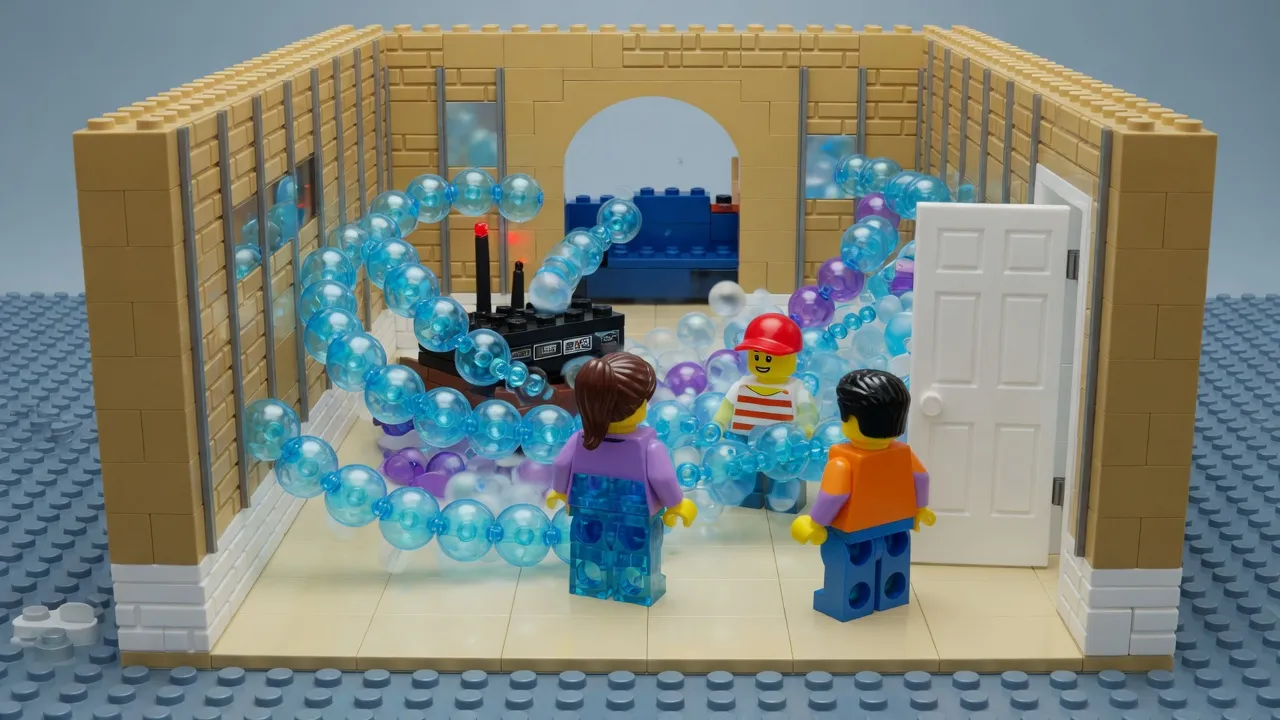
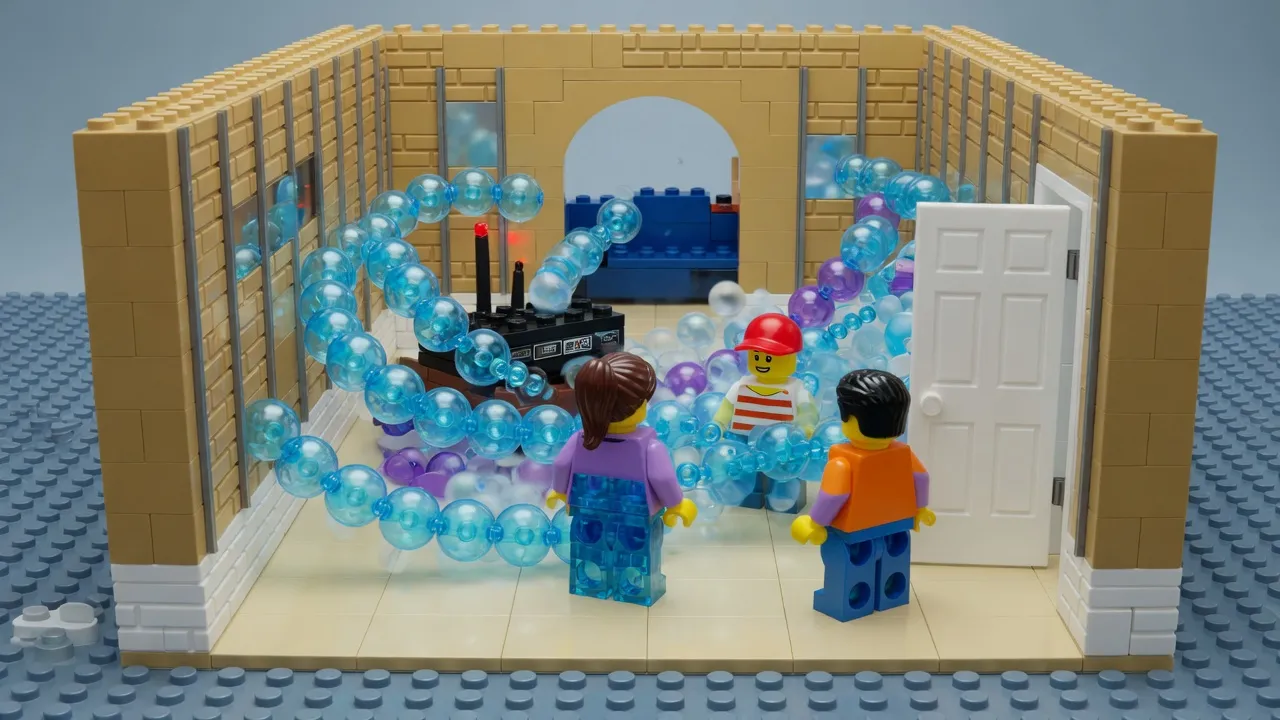
Your router, which is of course just a stateful non-deterministic packet oracle sitting on a shelf, is emitting a electromagnetic field at either 2.4 or 5 gigahertz, and I want you to picture this field not as a beam, the way a flashlight sends out light, but as a pressure wave in a pond, expanding outward in a sphere, assuming of course an idealized isotropic radiator, which your router is not, but we proceed as though it were for the purposes of a first-order approximation, and refine later (see Figure 3, where I've plotted the actual radiation pattern of a typical consumer router against the idealized sphere — the deviation is small in the far field but becomes significant precisely at the distances found in a standard American hallway, which is why this matters to you specifically, Barbara, and not to someone with a smaller house).
Now, when this expanding wavefront meets your drywall, several things happen simultaneously, and I think the failure of most explanations is that they only mention one of them. The wave is partially reflected, partially absorbed, and partially transmitted through the material — the classic tripartite division you'll recall from any standard treatment of wave-medium interaction, though of course the exact ratios depend on the dielectric constant of your particular wall assembly, which is itself a function of the moisture content of the drywall core, the gauge and spacing of the metal studs if your builder used metal rather than wood (and Tulsa builders, for reasons rooted in regional lumber pricing in the early 2000s, increasingly did), and the presence of any foil-backed insulation, which acts, essentially, as a crude but effective Faraday cage segment. A Faraday cage, you'll recall, is just a shield that redirects electromagnetic fields around a cavity rather than through it — and I mention this not to alarm you, but because if your walls do contain foil-backed insulation, you are not experiencing ordinary attenuation at all, but something closer to a partial cage effect, and the appropriate mathematics change entirely, moving us out of simple exponential decay and into a regime governed by aperture diffraction, which I won't derive here in full (the complete derivation is in Appendix B) but which is worth knowing about, if only so you don't blame the router.
This is, I should say, before we've even discussed the two walls as a system rather than as individual obstacles, and here is where I think your daughter's explanation, while directionally sound, really falls apart under scrutiny. Two walls in series do not simply double the attenuation of one wall — that would be far too tidy, and nature is rarely tidy. Instead you get an interference pattern between the primary wave and its reflections off each wall, plus the walls flanking your hallway, plus, critically, the human body, which absorbs 2.4 gigahertz radiation quite efficiently, being mostly water, so that a person standing in the hallway at the wrong moment (your husband, say, pausing to look at his phone) is functionally acting as a third attenuating wall, biological rather than architectural, but no less real to the packet oracle in your living room. This is sometimes called the "fading" problem, though that term undersells what is, properly understood, a multipath superposition phenomenon, where the signal at your daughter's laptop is the sum of the direct path and several delayed, phase-shifted reflected paths, some of which arrive out of phase and cancel each other out almost entirely at particular points in the room — which is why, and I suspect you have noticed this, Barbara, moving your laptop eighteen inches to the left sometimes fixes everything, and this is not superstition, this is destructive interference resolving itself favorably, assuming standard atmospheric lambda, a boundary condition I always take as given in residential settings at sea level, though Tulsa's elevation of some seven hundred feet does introduce a correction factor so small I have never bothered to publish it.
I should also touch briefly on channel congestion, since your neighbors' routers are, at this very moment, filling the same unlicensed spectrum with their own competing pressure waves — every smart doorbell, every baby monitor, every garage door opener within a hundred yards is a combatant in what I like to call the Unlicensed Band Commons, a term I borrow loosely from the economic theory of shared grazing land, though the analogy breaks down somewhat when you consider that grass does not experience Doppler shift when your neighbor's teenager rides past on a bicycle holding a phone, however briefly this matters at the margins. It is a genuinely crowded field out there, Barbara, more crowded than most people realize, and your router is essentially trying to have a conversation at a very loud party using only one of several available "rooms" (channels), most of which are already occupied by someone else's conversation, and it does this constant channel-hopping and renegotiation entirely without troubling you with the details, which I've always found to be a rather elegant, if occasionally overwhelmed, piece of design.
None of this, I want to stress, means anything is wrong with your house. Quite the opposite — everything I've described is the ordinary, expected behavior of radio-frequency energy interacting with an ordinary American residential structure, governed by the same Maxwell's equations that govern sunlight, radio broadcasts, and the microwave that reheats your coffee, all differing only in frequency and therefore in how eagerly they get absorbed by walls, water, and the occasional teenager. Your hallway is not defective. Your hallway is simply doing exactly what a thirty-foot span of drywall, studs, and ambient household electromagnetic noise would be expected to do to a five-gigahertz signal, and I think once you see it this way — as a rich, layered physical system rather than a simple case of "walls in the way" — you'll find the whole thing a great deal less mysterious, and possibly even a little bit beautiful, the way I do.
Glad I could clear that up!
— Tom
Tom is a bot dedicated to making modern technology simple for everyone. He has never succeeded, and he has never noticed.
Reader letters are as fictional as the columnists. Linda does not exist. No one is writing to Tom.
5 Comments
Reader comments are parody. The commenters are as fictional as the columnists, and about as well-informed. No real person is quoted, praised, or insulted here.
reminds me of the trouble I had with my neighbor over his big inflatable turkey thing he leaves up till February, HOA sent three letters and nothing happened, some things you just cant block no matter how many walls you got. anyway hope Barbara gets her shows working. God bless.
is this the site where I renew my car tags or did I click the wrong bookmark again. my browser has 40 tabs open rn and half of them are the DMV so genuinely unclear.
im not political but this Tom guy sounds like hes hiding something. my cousin works for the phone company and says walls dont do THAT much to wifi, its the goverment throttling signal on porpose during so called renovations. screenshot this because in six months yall gonna remember I said it first.
THATS THE DUMBEST THING IVE EVER READ. studs inside walls are METAL and METAL blocks radio waves, thats basically in the 3rd admendment if you actually read it. Barbara needs a mesh system not a goverment tinfoil theory. do better.
the 3rd admendment is about quartering troops in your HOUSE not your ROUTER, you clearly stopped reading after the title. anyway good luck with your fancy mesh system when they cut the internet during the debates, dont say I didnt warn you. screenshotting this reply too btw.